
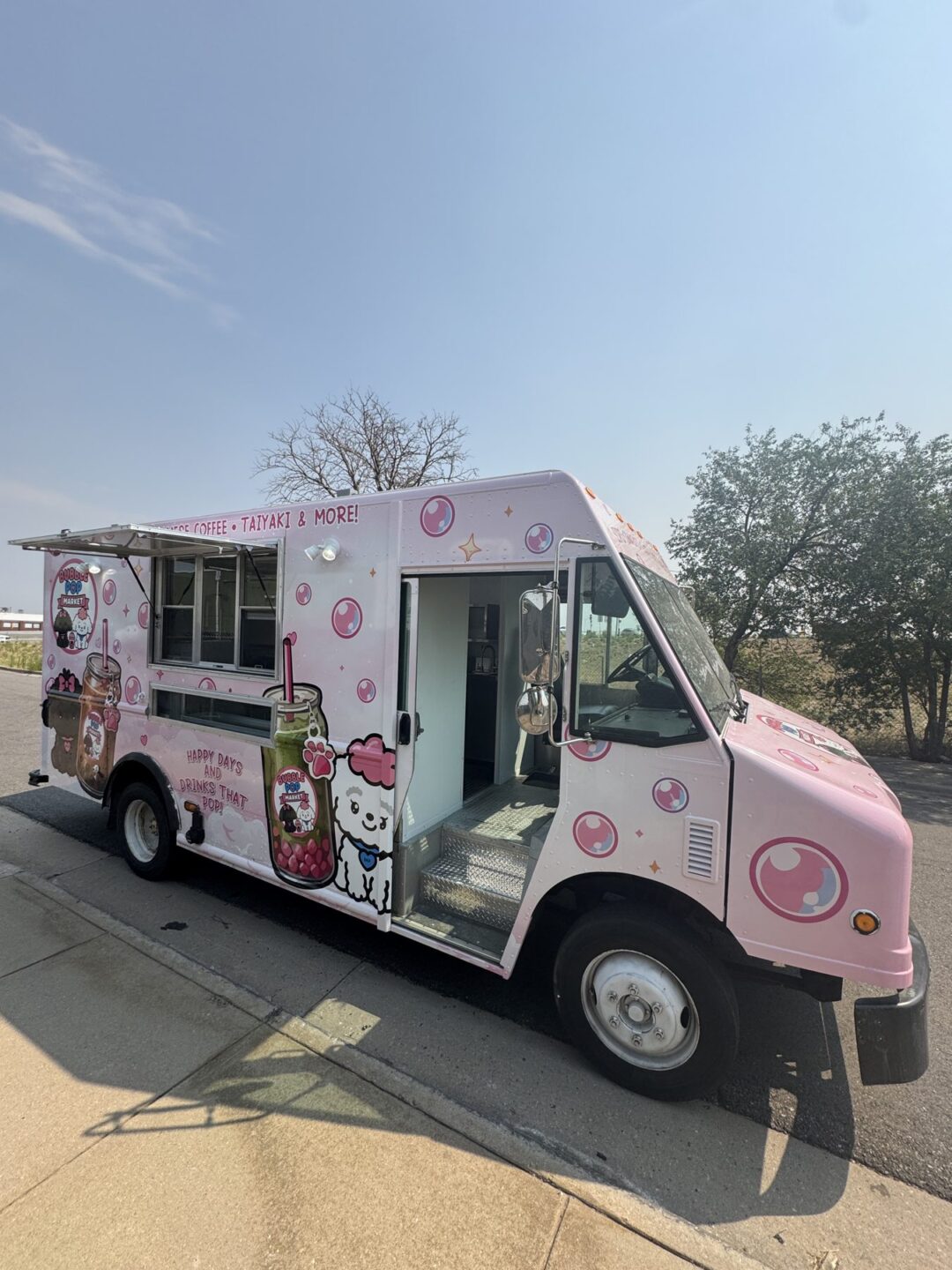
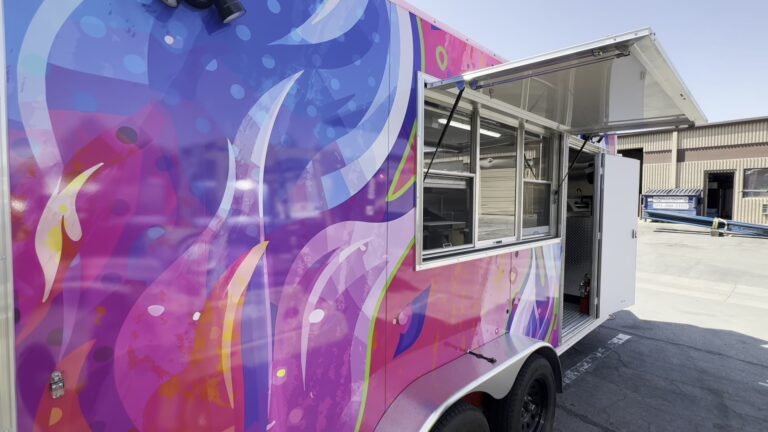
Bubble Pop Market sells boba, matcha, Vietnamese coffee and taiyaki in Fort Collins, and they wanted a truck as playful as the menu. What left our Denver shop was a pink 14ft diesel step van, and honestly, nothing cuter has ever rolled out of our doors.
Under the pink wrap is a drinks kitchen built from the bare shell up to move a boba line quickly, run quietly and get through a Colorado winter.
What they needed the truck to do
Boba trucks are closer to coffee bars than to burger trucks. No fryer, no grease hood, no suppression system. So the design time goes to water, ice, electricity and how quickly drinks reach the window.
The owners also sell plushies and prepackaged goods, and they wanted those on show without slowing drink orders. They also planned to work places where a generator would be unwelcome: farmers markets, weddings, the curb outside somebody’s shop.
How we laid it out
Follow a drink from order to hand off.
Orders come in at a 5ft by 3ft service window. Next to it is a second, separate display window, with a case behind the glass full of plushies and packaged items. Two openings means two jobs can run at once: one person makes drinks while the other handles merchandise, and a customer browsing toys never stalls the tea line.
Behind the service window is a 71 inch bubble tea workstation. It is one stainless piece with two built in sinks, hot and cold water taps and a drip tray, arranged like a boba shop counter. Because it is a single unit, the working height and reach never change from end to end.
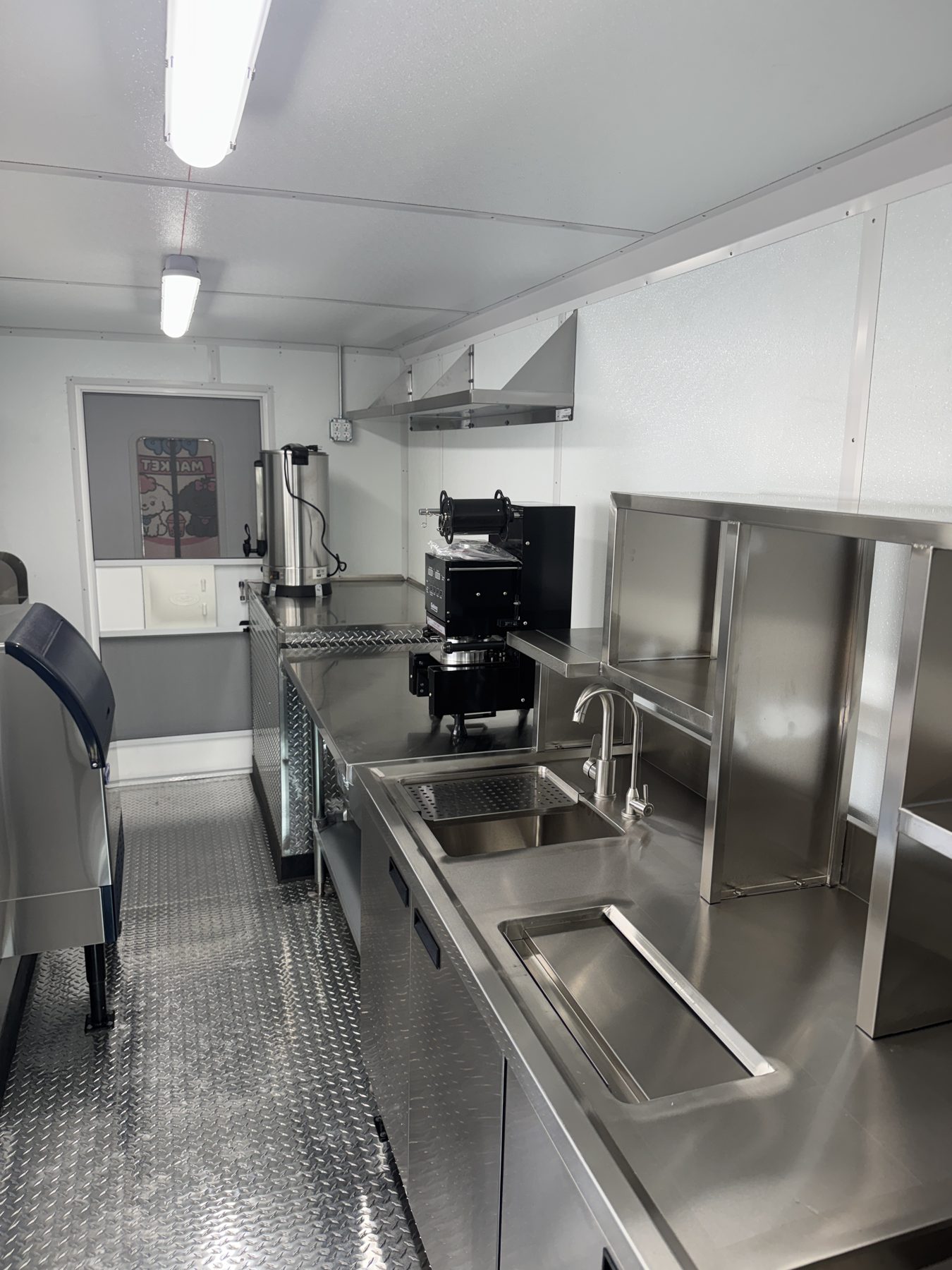
An Avantco IC18DB double induction hob, the truck’s one cooking surface, where the tapioca pearls are cooked. Its 1,800 watts are split between a 1,000 watt burner and an 800 watt burner.
A Vitamix 36019 The Quiet One, a 3 horsepower blender housed in a removable sound enclosure. On a truck, the customer is only a few feet from the blender, so keeping it quiet keeps the window friendly.
A Galaxy automatic cup sealer for 88 to 95 millimeter PP and PET cups, the first one we had ever installed.
An Atosa YR140-AP-161 undercounter ice machine. This air cooled unit produces 142 pounds of half dice ice a day and stores 88 pounds in its bin. That cube size chills a shaken drink quickly and slides through a wide boba straw. Its filter cartridge is mounted on the supply line where it can be changed without moving the machine.
An Avantco WB29L boiler for tea and matcha, 7.6 gallons, adjustable from 80F to 212F. Plan ahead with this one: from cold, it needs about an hour and a half, so the crew starts it at the commissary rather than at the event.
And an Atosa MBF8519GR reach in, 8.3 cubic feet. It is the low height model, so it fits beneath the shelving above.
Power, water and winter
Three power sources. This truck can draw power from three places, with a wall mounted transfer box to pick between them.
Shore power covers the commissary and any event with a hookup. A Westinghouse dual fuel generator lives in a lockable box. It is marketed as 12,500 watts, but that is starting power on gasoline. Running power, the figure to plan with, is 9,500 watts on gasoline and 8,500 on propane. The third source is a battery bank: an EcoFlow PRO power station plus a stacked extra battery, about 8 kilowatt hours combined, strapped to the floor beneath the counter.
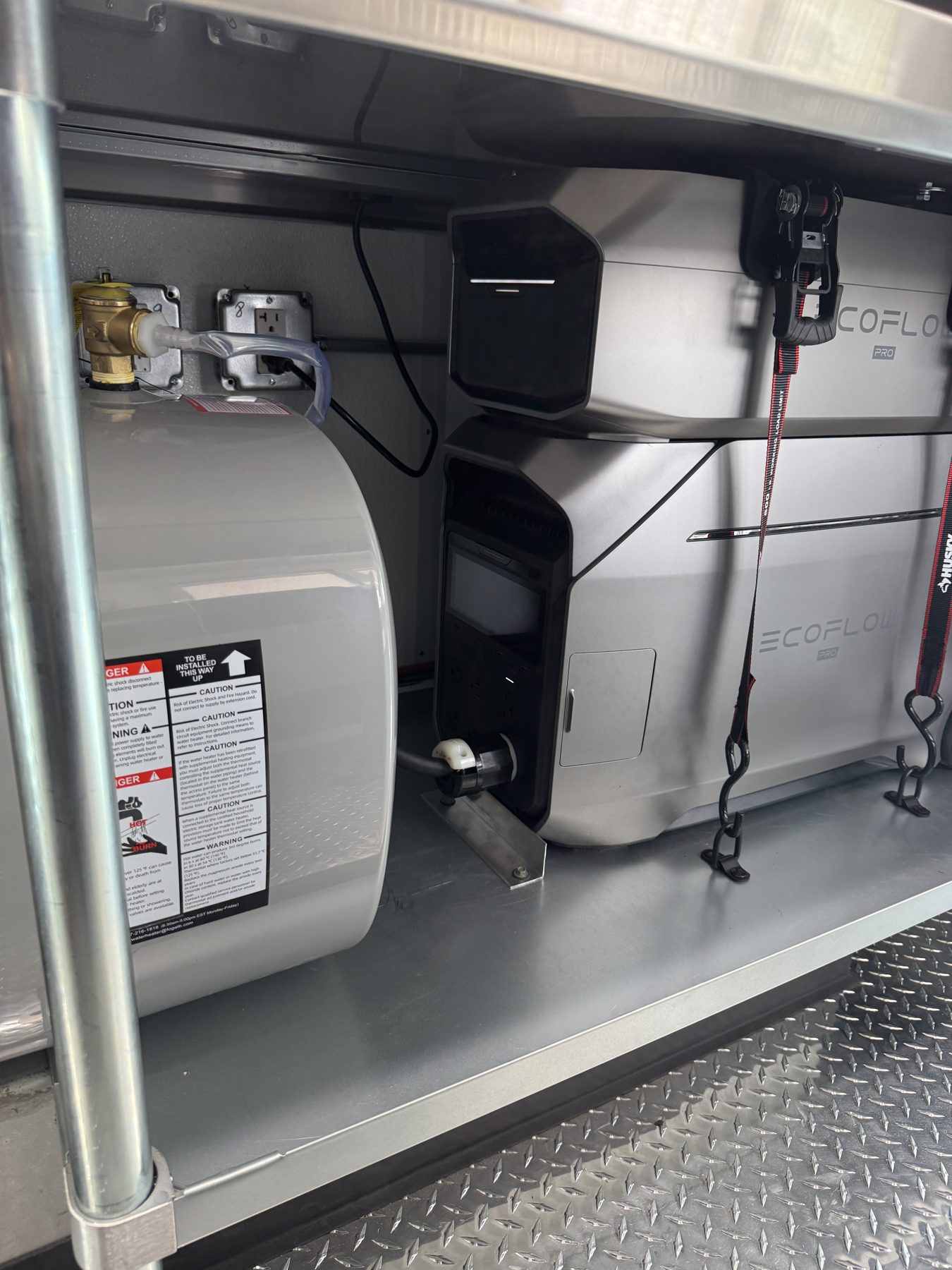
The battery works here because drinks are a light load. The heaviest draws are the 1,500 watt boiler and the 1,800 watt hob, 3,300 watts together, which the battery can supply continuously. The ice machine uses roughly 3 amps and the fridge roughly 2. The blender is the one to manage. It is a 15 amp machine, so when the truck is on battery alone, the crew runs it between boiler and hob cycles instead of stacking all three.
Power runs through a 125 amp panel with 12 outlets. Each item has its own labeled breaker, and the wiring is in conduit throughout. There are two outlet circuits on each side, then the fridge, water system, ice machine, lights, batteries and water heater. Nothing in this kitchen burns gas. LED lights inside and outside keep the window bright at night with little battery drain.
Water. The truck has two fill ports outside. One is for regular potable water that feeds the sinks. The other is for purified water used in drinks, kept on its own lines. The rest of the system is a 30 gallon fresh tank, 40 gallon waste tank, an 8 gallon water heater and a pump, serving a three compartment sink and a hand sink with splash guards and soap and towel dispensers. Larimer County requires the waste tank to be 15 percent or more larger than the fresh, and this one has plenty of margin.
Winter. Drinks trucks carry water all over: two fill lines, the boiler, the ice machine feed, the workstation, the heater and the sinks. Every one of those lines can be drained ahead of a hard freeze, which in Fort Collins is an October job, not a someday job. Walls and ceiling are FRP over an inch of insulation and half inch plywood, on purpose: with no cooking wall to protect, the stainless budget went to the bar and sinks. The floor is aluminum diamond plate. An air conditioner handles summer, and an RV door with a screen sits at the back.
Getting it licensed in Fort Collins
Three agencies, and the city goes last because it wants proof of the other two.
Larimer County Health Department is the licensing body for mobile food units here, not the city. The county separates full food service units from prepackaged only ones, and a boba truck falls under full service. Expect a plan review, an on site review and a pre opening inspection before your license is issued. You also need a commissary or base kitchen that the truck returns to every day it trades, no farther than 60 minutes or 60 miles for multi day events. Have that agreement signed before filing, since the county will request it.
The City of Fort Collins manages its own sales tax, so get a city sales and use tax license alongside your state license. Next is the Outdoor Vendor License, which the city only grants after you have the sales tax license, your county health license and a Poudre Fire Authority inspection, along with general liability and products liability insurance.
Fort Collins rules are tighter than in many Colorado cities. Trucks cannot vend from 3am to 7am, and typically cannot stay in one location more than three days a week. Anything within 200 feet of K through 12 school property is off limits, and so are parks, trails, residential neighborhood zones, and Colorado State University or school district land. Downtown, only six approved concessionaire spots are allowed. Street vending is limited to parallel parking areas, parked within 12 inches of the curb and 10 feet or more from any building entrance.
Poudre Fire Authority permits and inspects every mobile food vehicle once a year. All trucks need an ABC extinguisher, and Class K only applies where cooking creates grease laden vapor. With no fryer or hood, fire review is one of the easier steps for this truck. Fort Collins switched to the 2024 International Fire Code in May 2025. Since January 1, 2026, HB 25-1295 lets other Colorado local governments honor a fire safety permit if a certified inspector issued it under current codes and you give 14 days notice, which makes Loveland, Greeley and other Front Range events much simpler.
See our Fort Collins food truck builder page for more on building in the area. We also took a cold menu truck through the same three agencies for an açaí bowl business in Fort Collins.
If you are planning something similar
Start with water. On a drinks menu, nearly everything in the cup begins as water. A separate purified fill and a boiler matched to your volume set the layout.
Run the power numbers honestly. Battery only service works when the biggest loads fit what the battery can supply. Here the boiler and hob fit, and the blender is timed around them. Plan generators on running watts, not starting watts.
Make every water line drainable. One forgotten line on a freezing night in Colorado can cost you a pump.
Questions we get about this build
Do boba trucks need a hood and fire suppression?
Generally no. Hoods and suppression are required over cooking that throws off grease laden vapor, such as fryers and griddles. This truck cooks pearls on induction and pours drinks, so it needs neither. Poudre Fire Authority still requires an ABC extinguisher and a yearly mobile food vehicle permit and inspection.
Can a food truck run on battery power?
A drinks truck can for a good part of a shift. This one has an EcoFlow PRO battery bank of roughly 8 kilowatt hours, a dual fuel generator and shore power, all switched through a transfer box. Its two largest loads, the 1,500 watt boiler and 1,800 watt induction hob, are within the battery’s continuous output, and the crew runs the blender between them.
How much water does this boba truck hold?
Thirty gallons fresh and forty gallons waste, with a separate purified water fill for drinks and a 7.6 gallon boiler for hot water. Larimer County requires a waste tank at least 15 percent larger than the fresh tank.
Can food trucks vend at Colorado State University?
No. Fort Collins vendor rules exclude Colorado State University and school district property, along with anywhere within 200 feet of K through 12 school property. Trucks reach students from private lots nearby and at events.
How long does a build like this take?
About six weeks from order.
Planning a drinks concept of your own? We will walk through water, ice and power with you before anything gets drawn. See finished trucks in our gallery, then reach us through the quote form or call the Denver shop at 720-209-2653. We are at 3895 E 45th Ave Suite E and build for owners across the Front Range and beyond.
Planning a build like this?
Tell us what you want to cook and where you will park. We will send a layout and a written quote.
Get a free quoteCall 720-209-2653
Recent Comments