
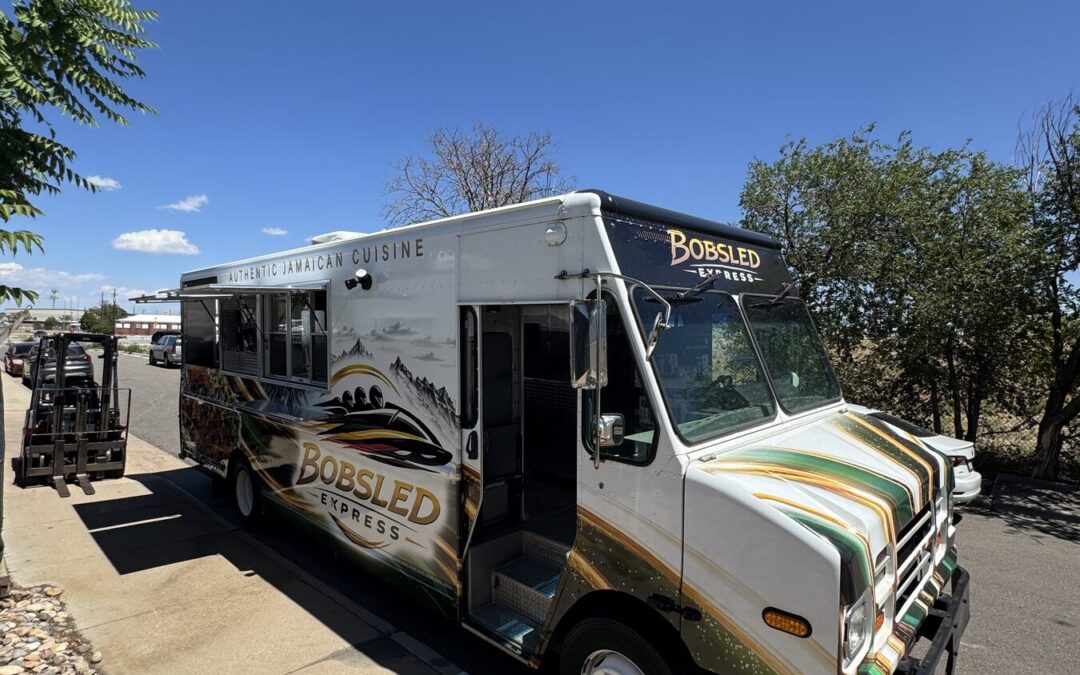
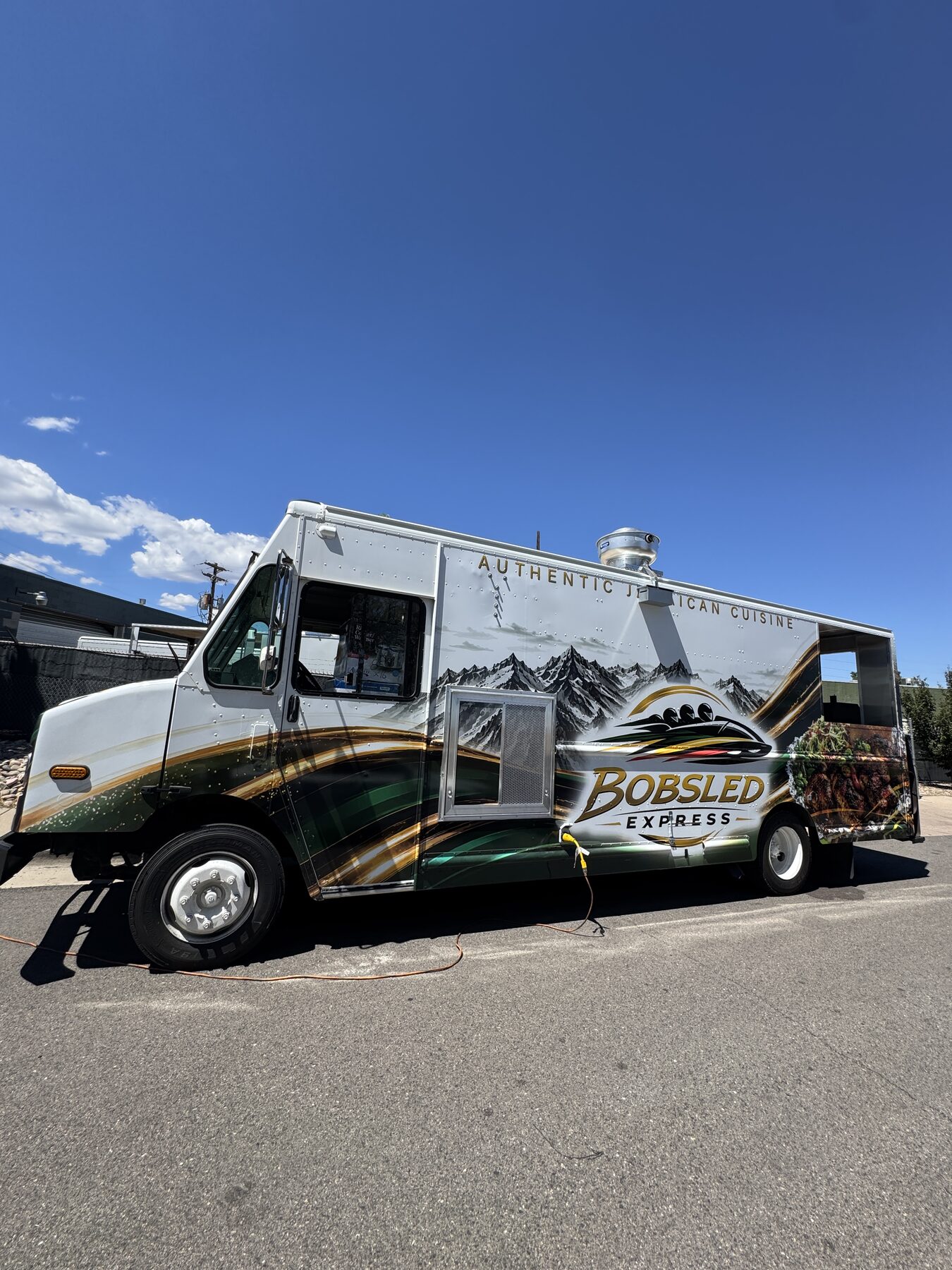
You cannot fake charcoal. That is the whole problem with building a jerk chicken truck, and it is the reason the back six feet of this one is not a kitchen at all.
Jerk is a smoke method before it is a spice blend. The marinade matters, but what turns marinated chicken into jerk chicken is hours over live coals with the lid down. Put that same chicken on a flat top and you get a good piece of grilled chicken and a disappointed Jamaican customer. There is no griddle setting that produces smoke.
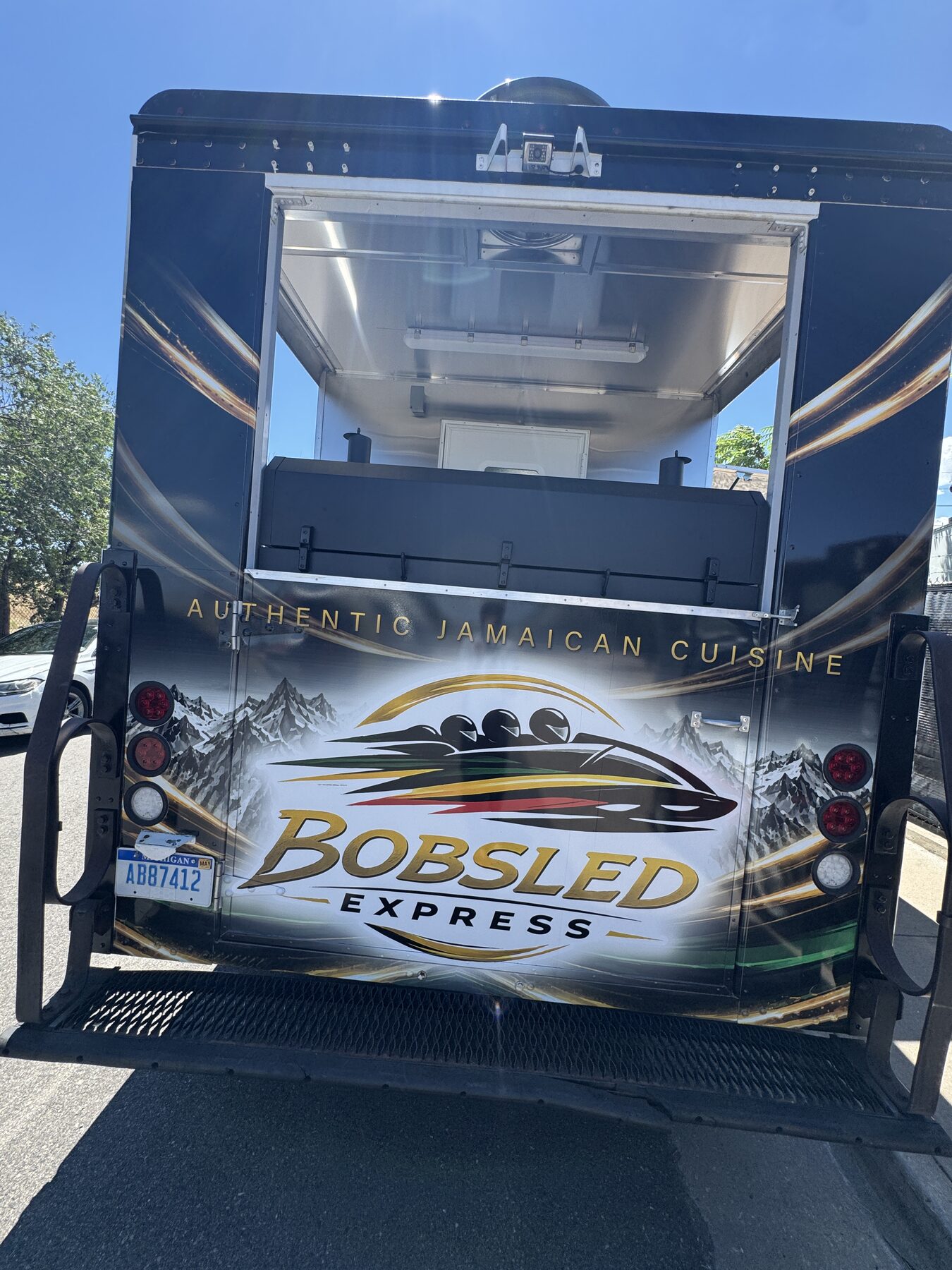
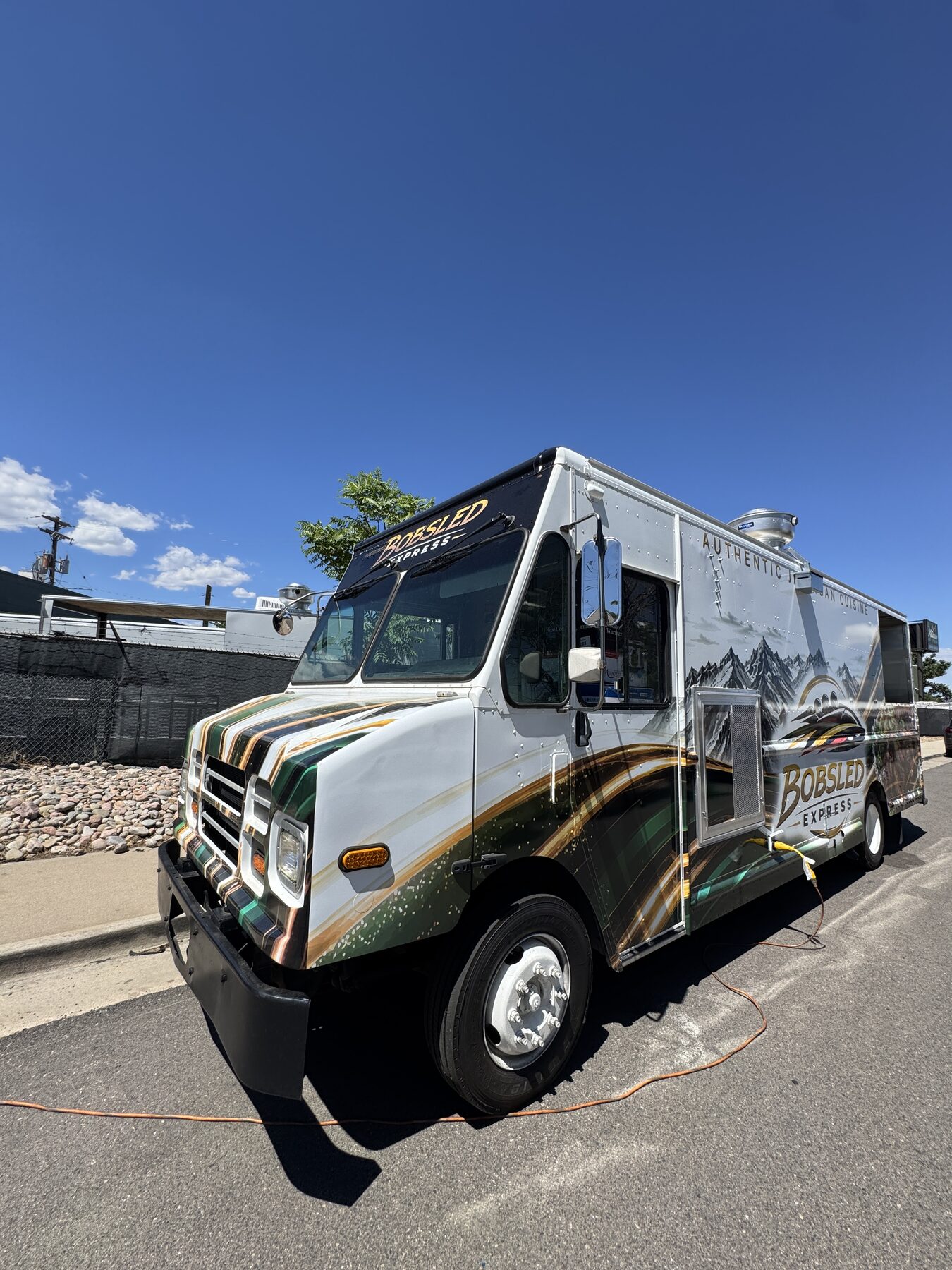
So when Bobsled Express came to us for a Jamaican truck bound for Laramie, Wyoming, the first decision was not the layout or the wrap. It was where the charcoal was going to live. The answer was a twenty foot body with the last six feet given over to an open porch, and a sixty inch charcoal smoker standing in it under its own canopy and its own fan.
Walkthrough video
The back six feet became a porch
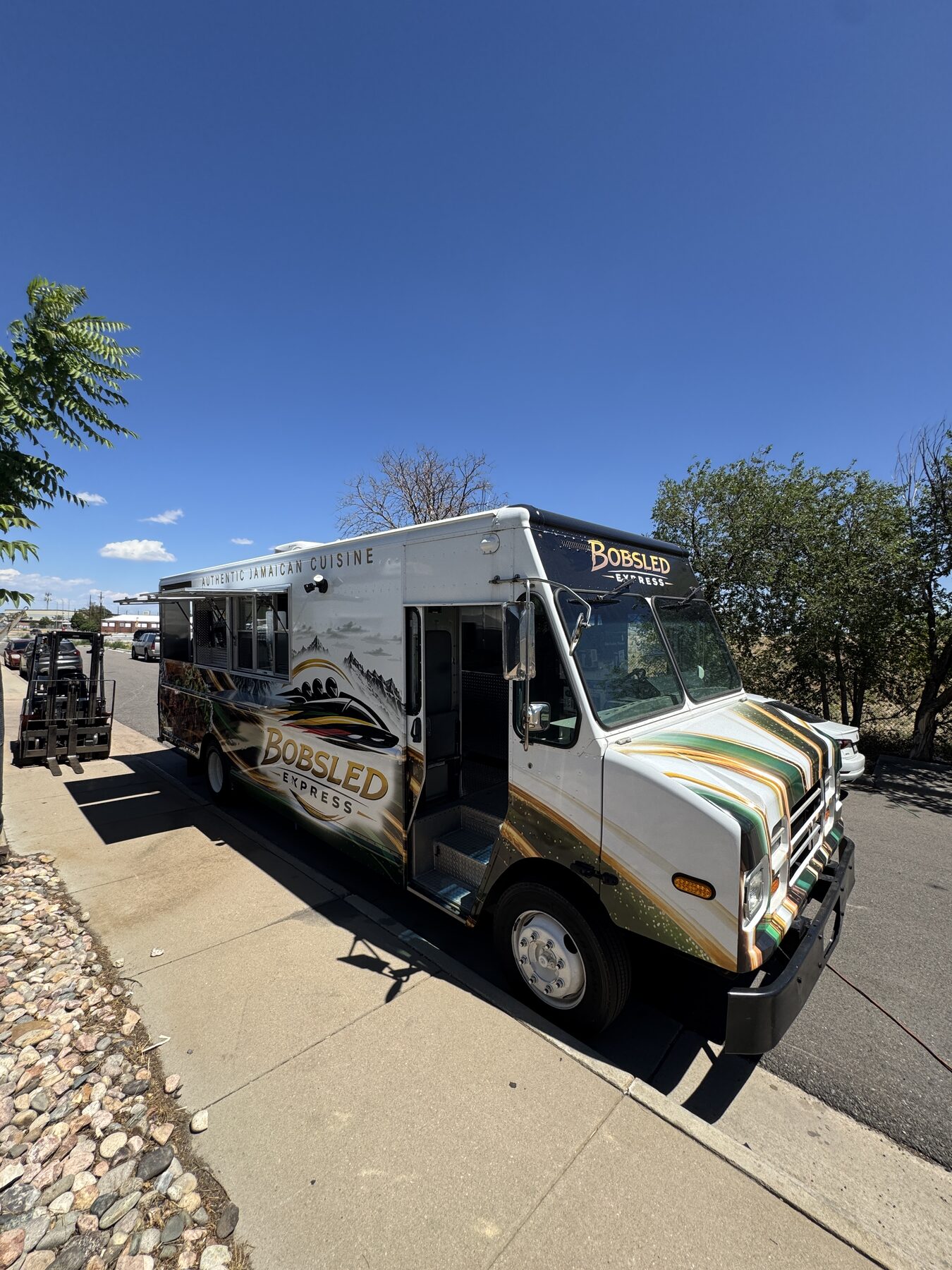
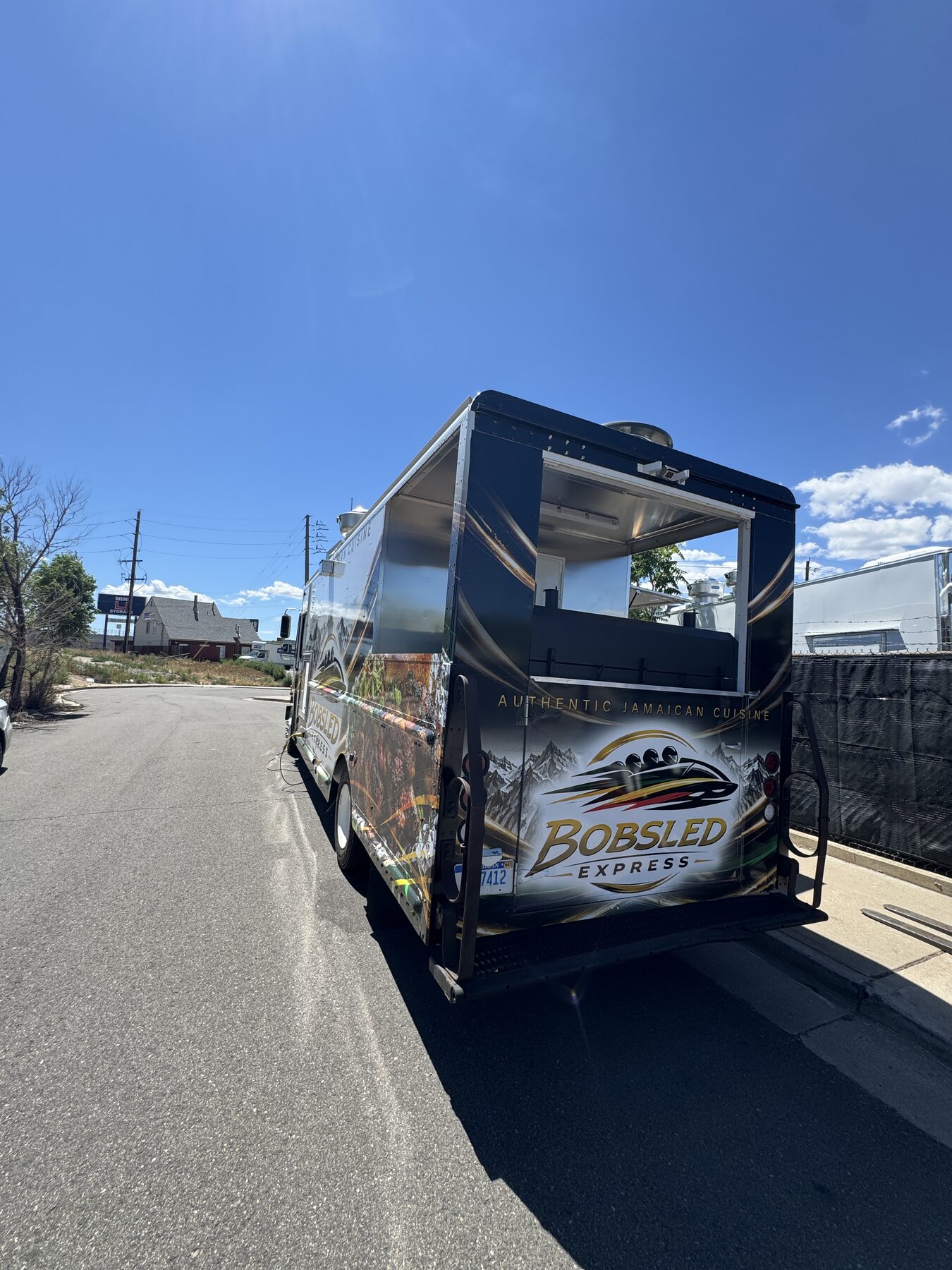
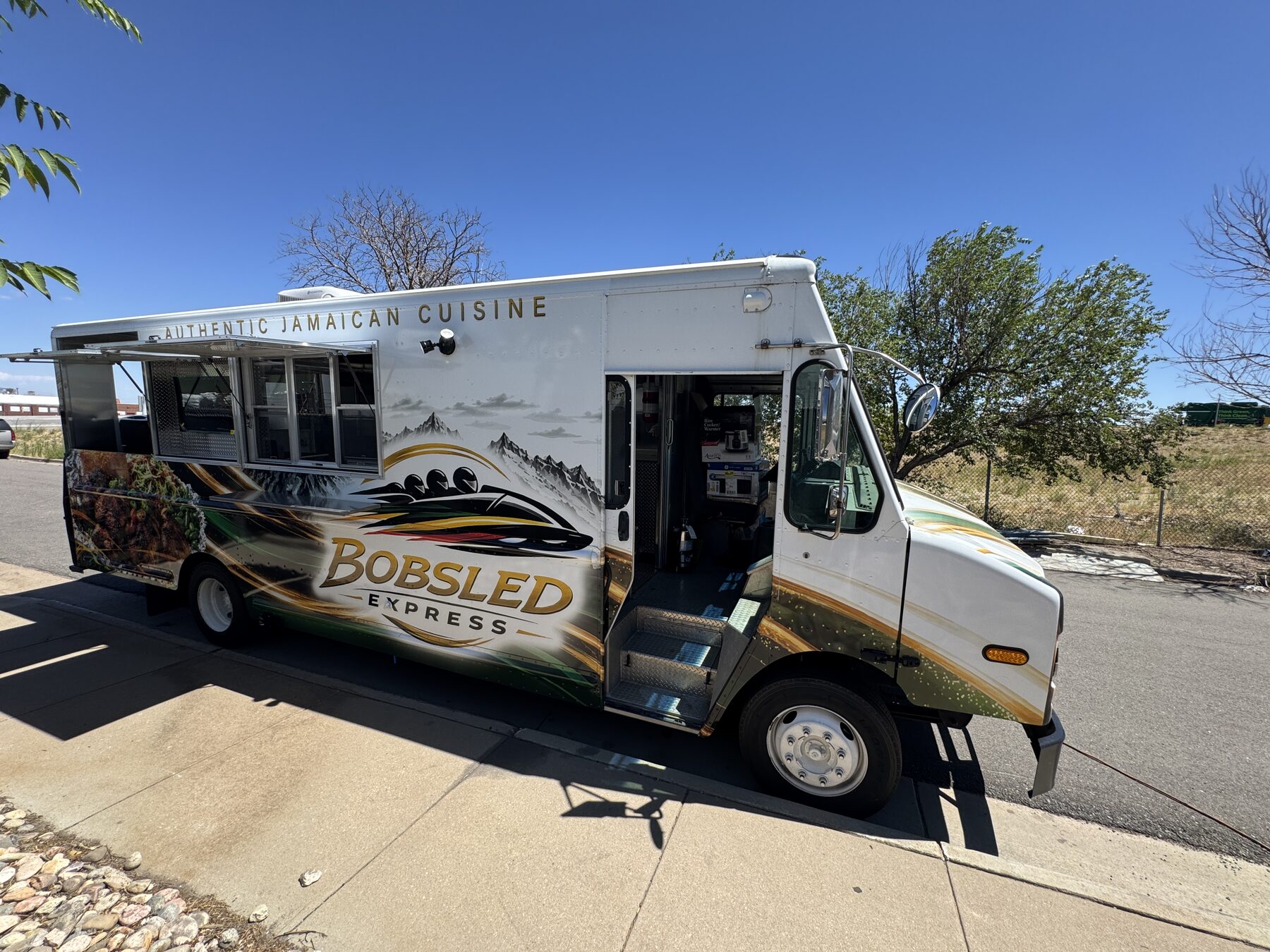
The truck is a twenty foot step van. Fourteen feet of that is the kitchen. The remaining six feet at the back has no floor cabinets, no hood and no walls across the rear. It is an open deck, and it exists so that live fire never enters the room where the gas lines and the fryer are.
Putting a charcoal grill inside a food truck is possible and it is almost always a mistake. Charcoal produces heat you cannot turn off, smoke you have to move and ash you have to deal with. In a kitchen that already holds a range, a griddle, a fryer and a steam table, a charcoal appliance inside means a bigger hood, a much harder fire conversation, a hotter room and a cook standing in smoke for eight hours. In Wyoming in July, with the air conditioner also running, the kitchen loses that fight.
On the porch the arithmetic reverses. Heat and smoke stay outdoors. The smoker gets a canopy and an exhaust fan of its own rather than competing for the main hood. The cook works the coals from a dedicated position instead of turning around into them. And the inside of the truck stays a normal, workable commercial kitchen.
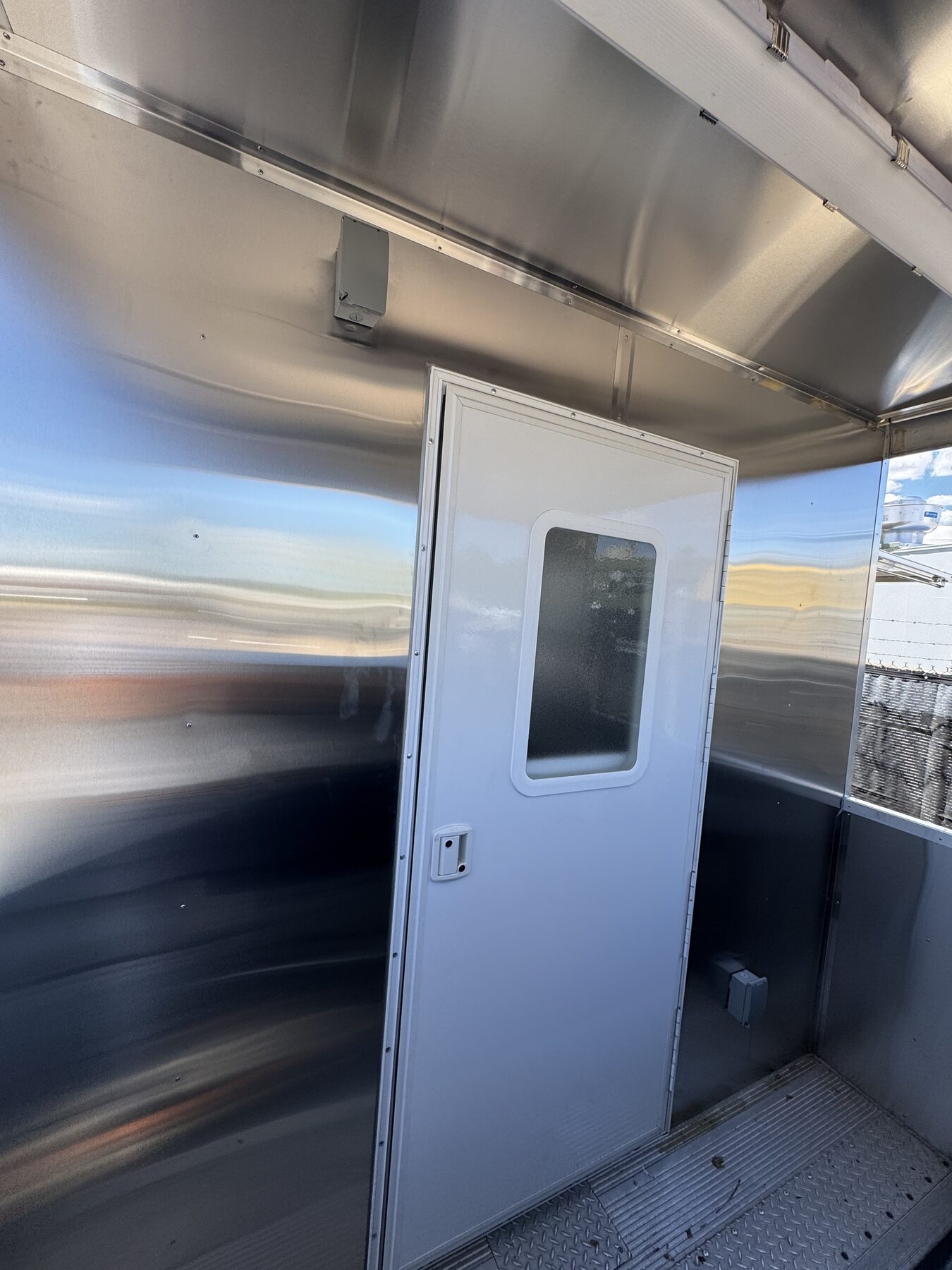
The part that took the longest to agree was the doorway. A porch is useless if the only way to reach it is by walking around the outside of the truck, and it is worse than useless if the kitchen door has to be propped open in a Laramie wind. So the porch and the kitchen are separated by an RV door with a window in it. The cook can see the coals from the line, and the door still shuts.
The porch is wired as its own zone. Looking at the panel, circuit five is the porch light and fan, circuit six is a porch outlet and circuit twelve is a second one. That is not decoration. Jerk service runs long after dark at a tailgate, and a grill position with no light and nowhere to plug a fan or a phone charger stops being a work station by about seven in the evening.
The smoker itself
The appliance is a Backyard Pro 554SMOKR60AS, a sixty inch charcoal and wood smoker grill. It matters which one, because the specification decides how the truck cooks.
- 1,102 square inches of stainless cooking grate, which is roughly fifty to sixty pieces of chicken at a time depending on how they are cut
- Three grate heights, at eight, ten and three eighths, and twelve and three quarter inches above the coals, so the same fire can sear and then hold
- A slide out ash tray on the side, which is the difference between a two minute clean down and a service that ends early
- Casters with brakes, so it rolls clear of the porch for cleaning and locks in place for service
- Two thermometers and adjustable chimney flaps, so the cook is regulating airflow rather than guessing
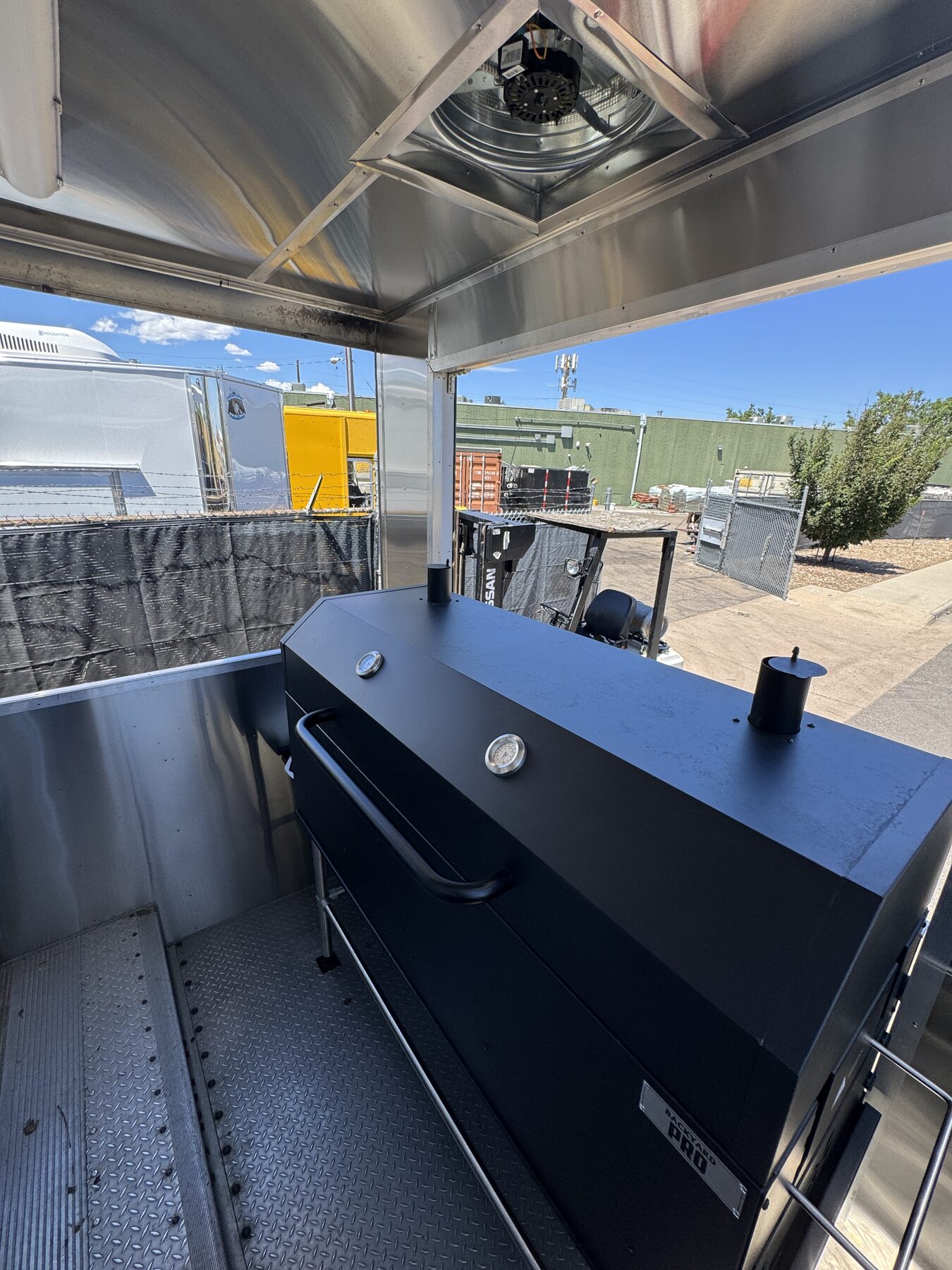
The three grate positions are the feature that earns its place on a jerk menu. Jerk chicken wants a long spell high off the fire with the dome down, and then a short spell low for colour before it goes out the window. On a fixed grate you either burn the skin or you serve pale chicken. Being able to drop the grate for the last four minutes is the whole game.
What the fire code actually says about charcoal on a truck, and what it does not
This is the part worth reading carefully if you are planning a similar build, because the honest answer is that the model codes do not squarely address it.
The fire code section written specifically for mobile food preparation vehicles is about cooking equipment that produces grease laden vapours, and it deals with hoods, automatic suppression, LP gas capacity and cooking oil storage. Read it end to end and it does not mention solid fuel, charcoal or open flame at all. The section was written on the assumption that food trucks cook with gas or electricity.
Solid fuel cooking is dealt with elsewhere in the code, in the commercial kitchen hood provisions, and that material is demanding. It contemplates noncombustible flooring extending three feet in all directions, three feet of horizontal and six feet of vertical clearance to combustibles, a fire rated room for fuel storage, a fixed water supply with a hose at the cooking location, ash removed daily and stored cooled in covered metal containers, and, importantly, an exhaust system for the solid fuel appliance that is independent of every other exhaust system on the premises.
That last requirement is the one this build satisfies by design. The smoker has its own canopy and its own fan on the porch, and it is not tied into the six foot Type 1 hood serving the range and the fryer. If you take one thing from this article into your own build, take that. Never duct a charcoal appliance into the same system as your gas line.
What nobody can tell you from a code book is whether an appliance standing on an open porch at the back of a mobile unit is judged under the commercial kitchen hood rules or as outdoor cooking equipment reviewed case by case. We could not find a Wyoming or Laramie provision that resolves it, and the City of Laramie has adopted the International Fire Code by a most recent edition clause without amending either section. In practice that means the fire code official decides. So the real advice is procedural rather than technical. Book a pre application conversation with Laramie Code Administration on 307-721-5271 and walk them through the smoker, the exhaust, the clearances and your ash plan before anything is fabricated. Doing that costs an afternoon. Discovering it afterwards costs a rebuild.
The cook line inside
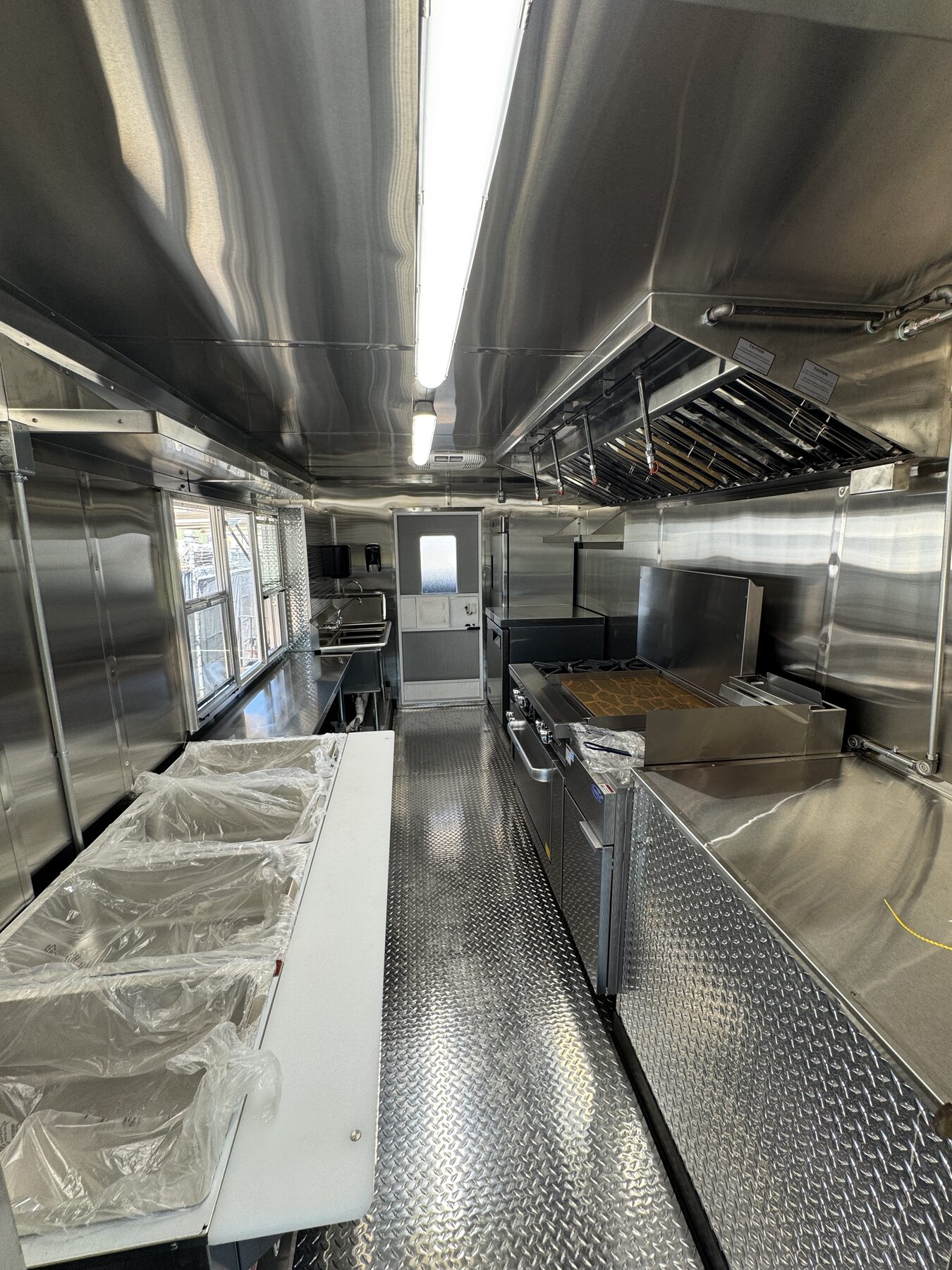
Outside the smoker this is a serious kitchen rather than a one trick truck, because a jerk menu is not only jerk. Oxtail, curry goat, rice and peas, festival and plantain all have to come off the same fourteen feet.
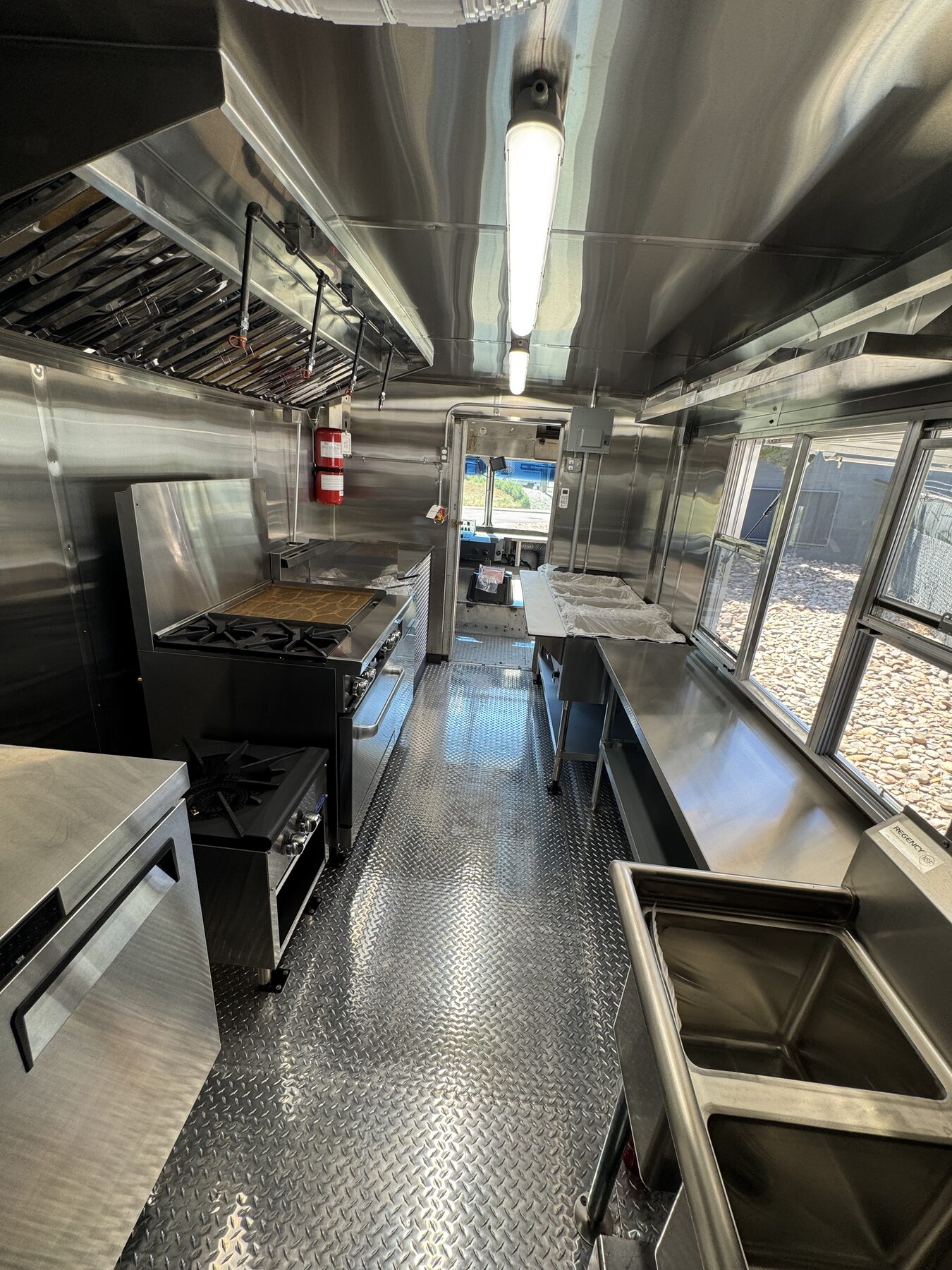
Above the hot side is a six foot Type 1 hood, NSF approved to Colorado requirements, with a wet chemical fire suppression system over the appliances. Under it, from the front of the line back:
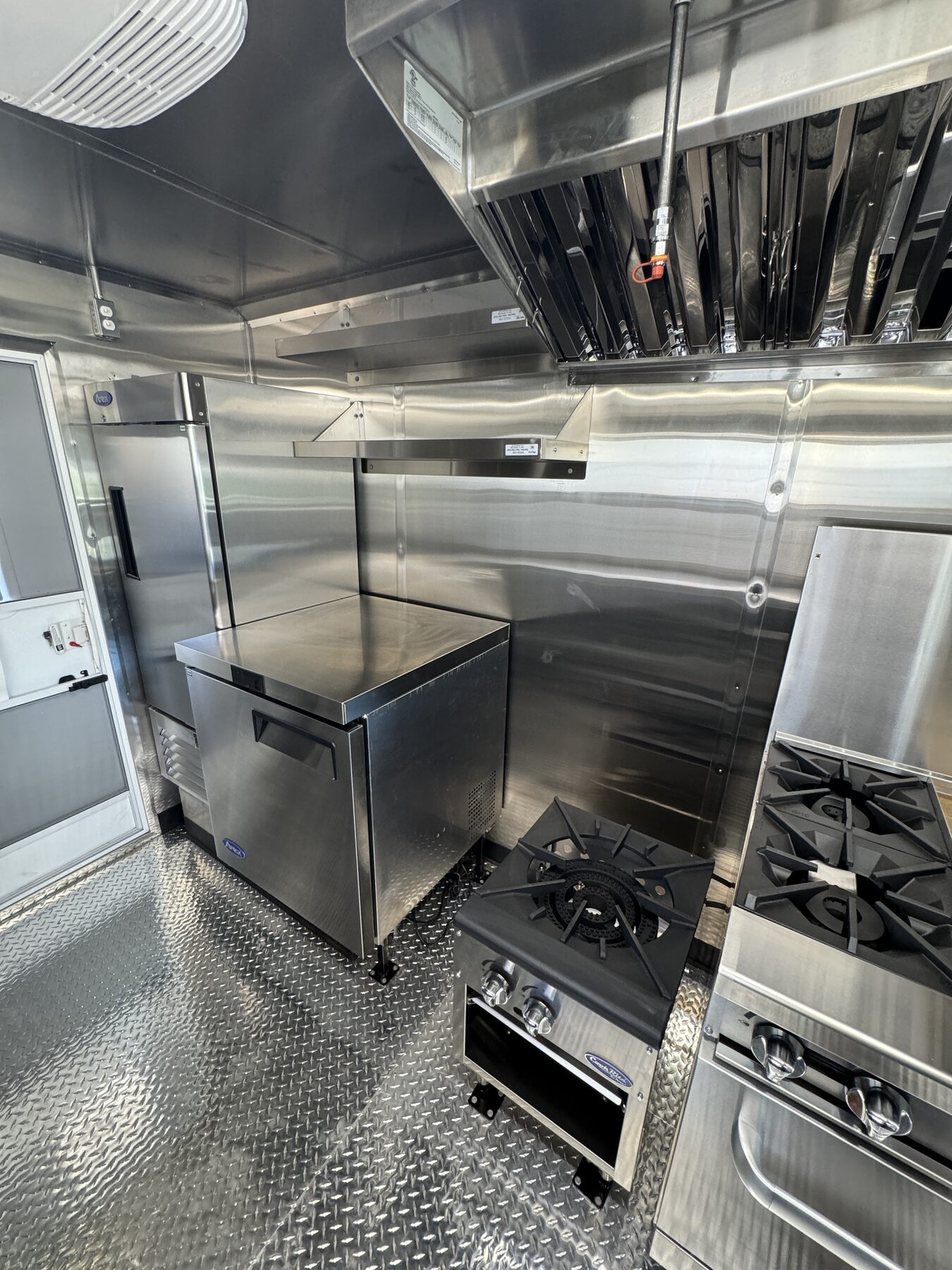
- An Atosa AGR-2B24GR-LP range, thirty six inches wide, two open burners on the left and a twenty four inch griddle on the right with a standard oven underneath, 118,000 BTU on propane
- An Atosa ATFS-40-LP floor fryer, forty pounds of oil, for festival and plantain
- An Atosa ATSP-18-1 single stock pot stove, eighteen inches wide and 80,000 BTU, which exists purely so the pot work does not fight the range for space
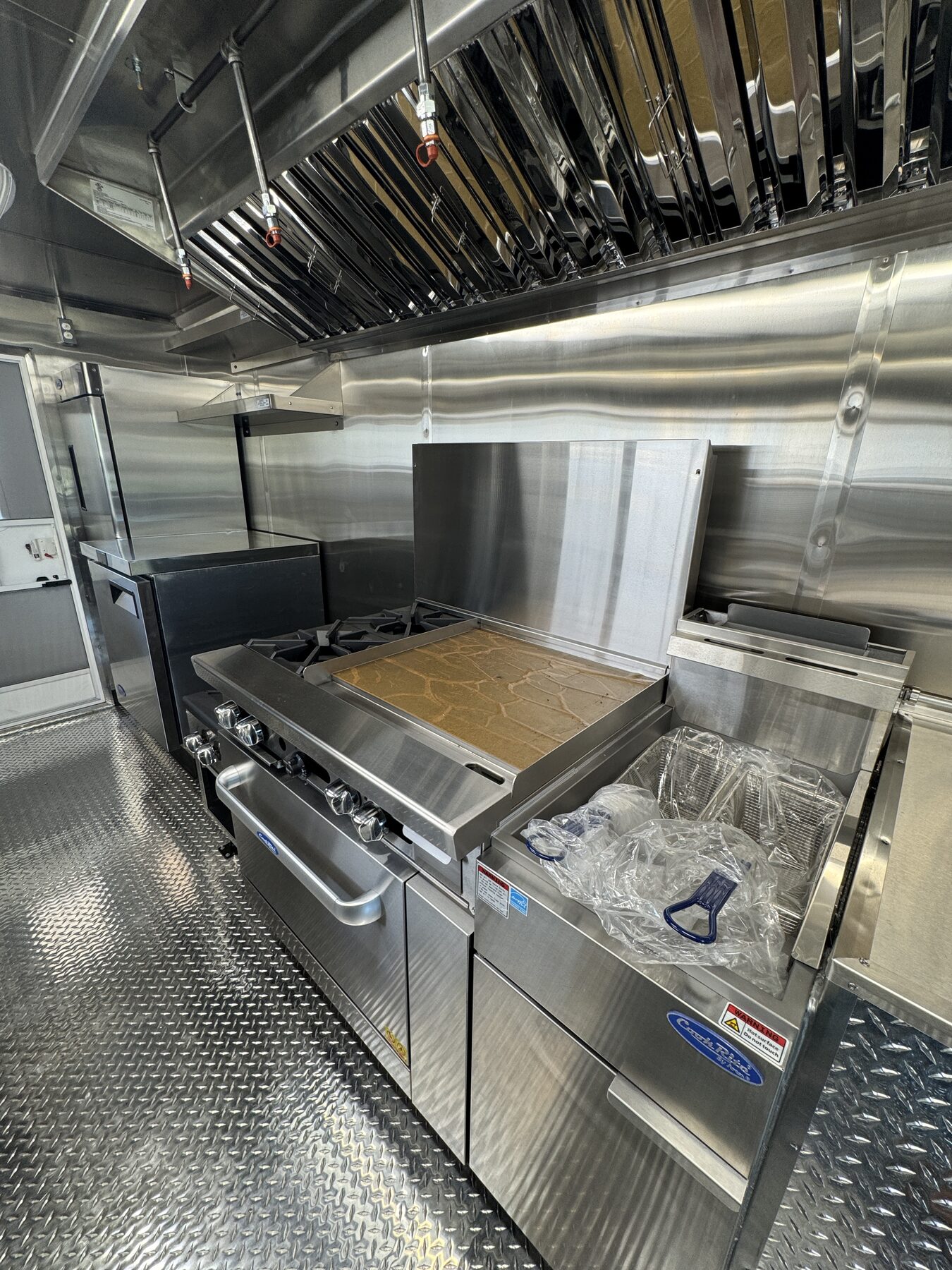
The stock pot stove is the line item people cut and then regret. On a Jamaican menu the pots are the menu. Oxtail and curry goat are long braises, rice and peas needs its own burner, and jerk sauce wants somewhere to sit. Take the stock pot stove out and every one of those jobs moves onto the two open burners that the range also needs for service.
Cold storage sits at the back end of the run, closest to the porch door:
- An Atosa MBF8519GR reach in refrigerator, 8.3 cubic feet in a twenty four inch footprint. It is the low height model, which is the version made for trucks because it clears an overhead cabinet run that a full height reach in would not
- An Atosa MGF8405GRL undercounter freezer, 7.15 cubic feet at twenty seven and a half inches wide, specified with the left hand hinge so the door opens away from the aisle rather than into the person walking past it
- A Sharp R-21LCFS commercial microwave
The window, the sinks and the water
The service window is five feet by three feet in three sections, and it is self closing. That last word is the one that matters at altitude and in wind. A three section window that has to be propped is a window that slams at the wrong moment; a self closing window is a window that behaves the same at a July tailgate and on a windy October evening.
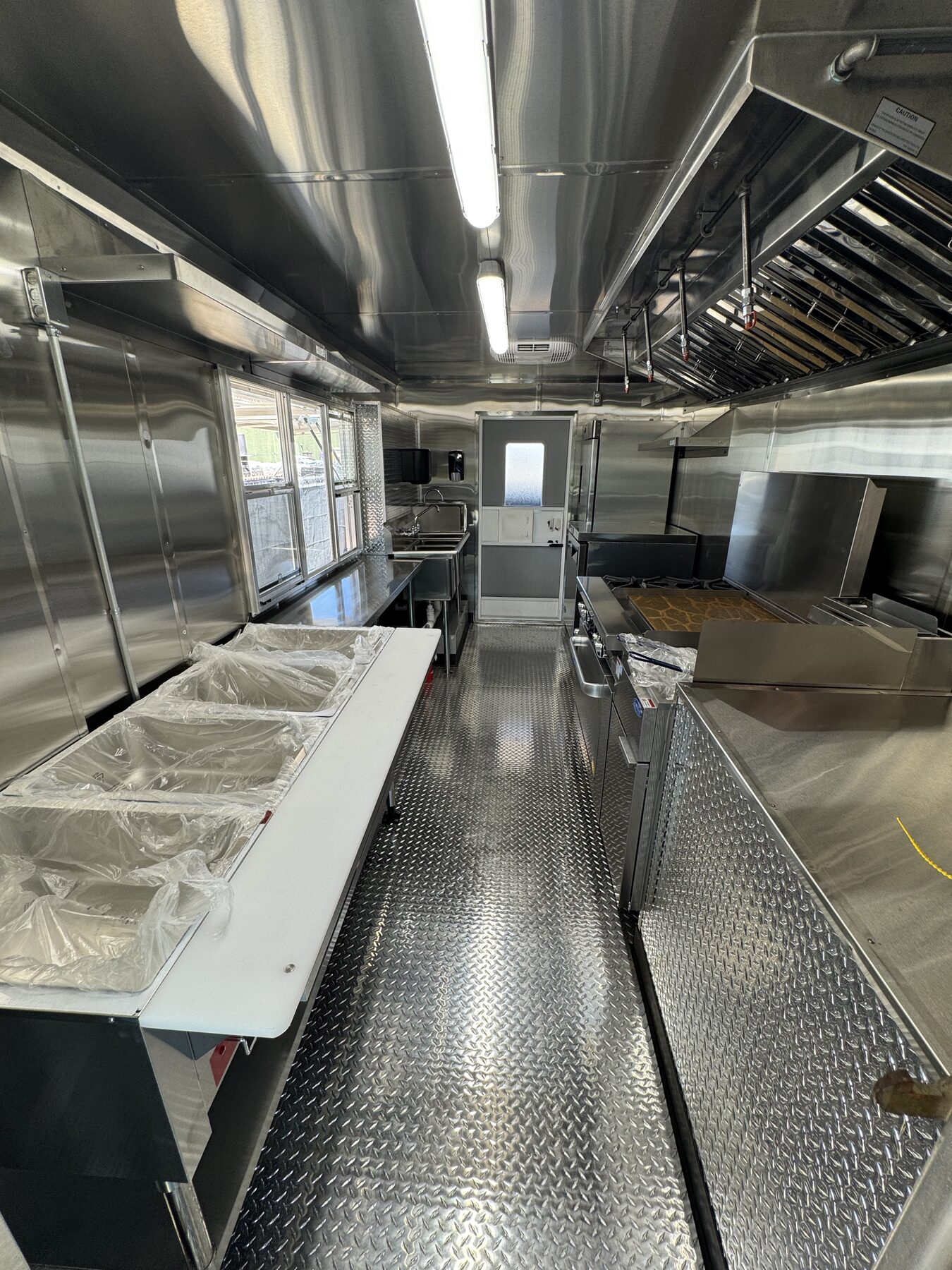
Directly under the window is the four pan steam table, an Eagle Group HT4 rated at 14,000 BTU. Holding happens where handing out happens, so a plate is two steps rather than six. On the opposite side there is a long stainless counter and a poly top prep table.
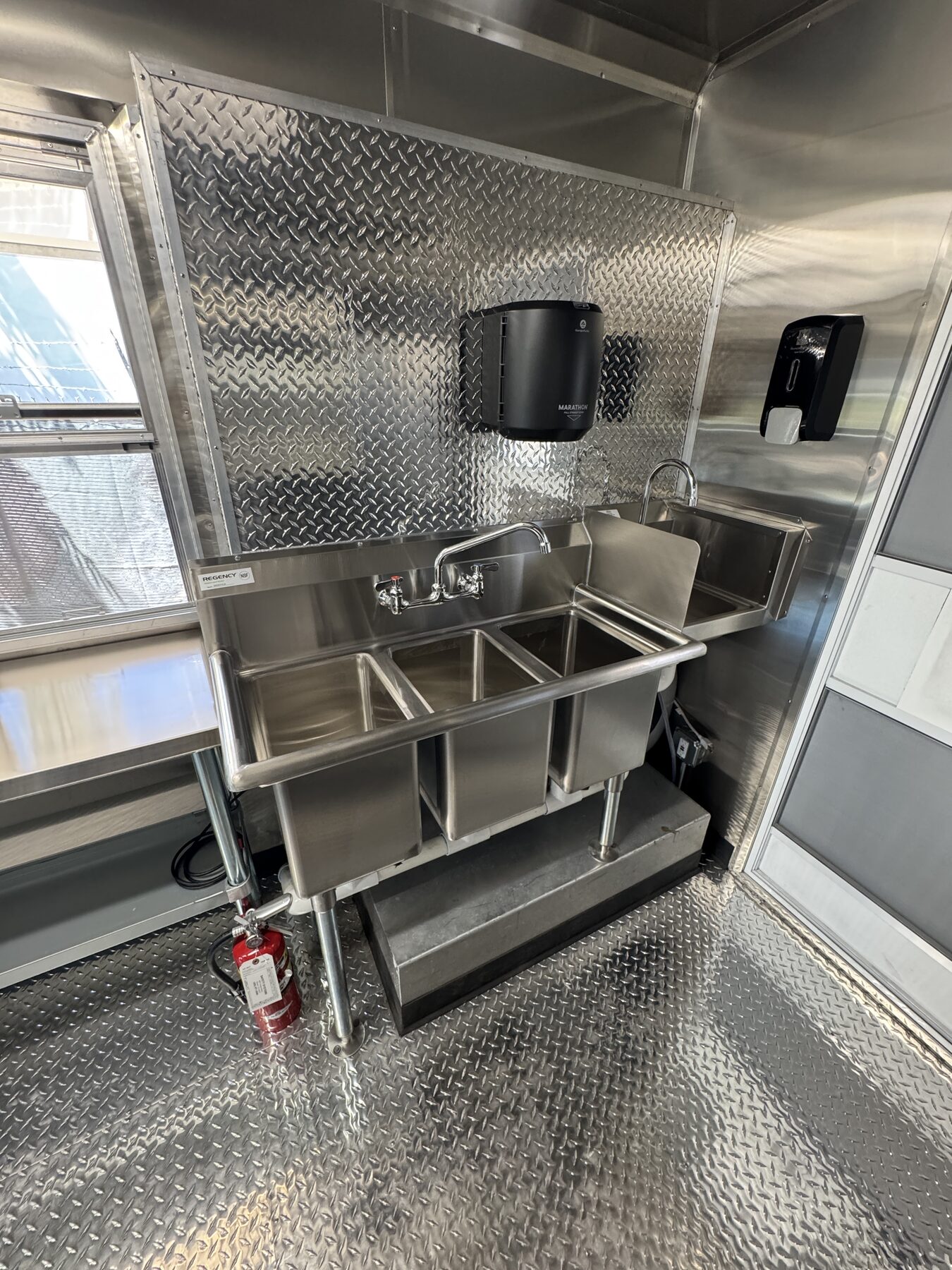
Plumbing is a three compartment sink, a separate hand sink and a mop sink. The mop sink is the one that gets argued about, because it takes floor space that a cook would rather have. It stays in because the alternative is somebody rinsing a mop in the three compartment sink, which is the single fastest way to fail an inspection you were otherwise going to pass.
Water is a thirty gallon fresh tank and a forty gallon waste tank, with an eight gallon water heater. The Wyoming Food Safety Rule requires the waste tank to be at least fifteen percent larger than the fresh tank. Forty against thirty is thirty three percent larger, so this one is not sitting on the line, it is clear of it.
Power, air and the parts nobody photographs
The truck runs on a 125 amp panel with twelve outlets through the kitchen and the porch. Every breaker is labelled, all thirteen of them.
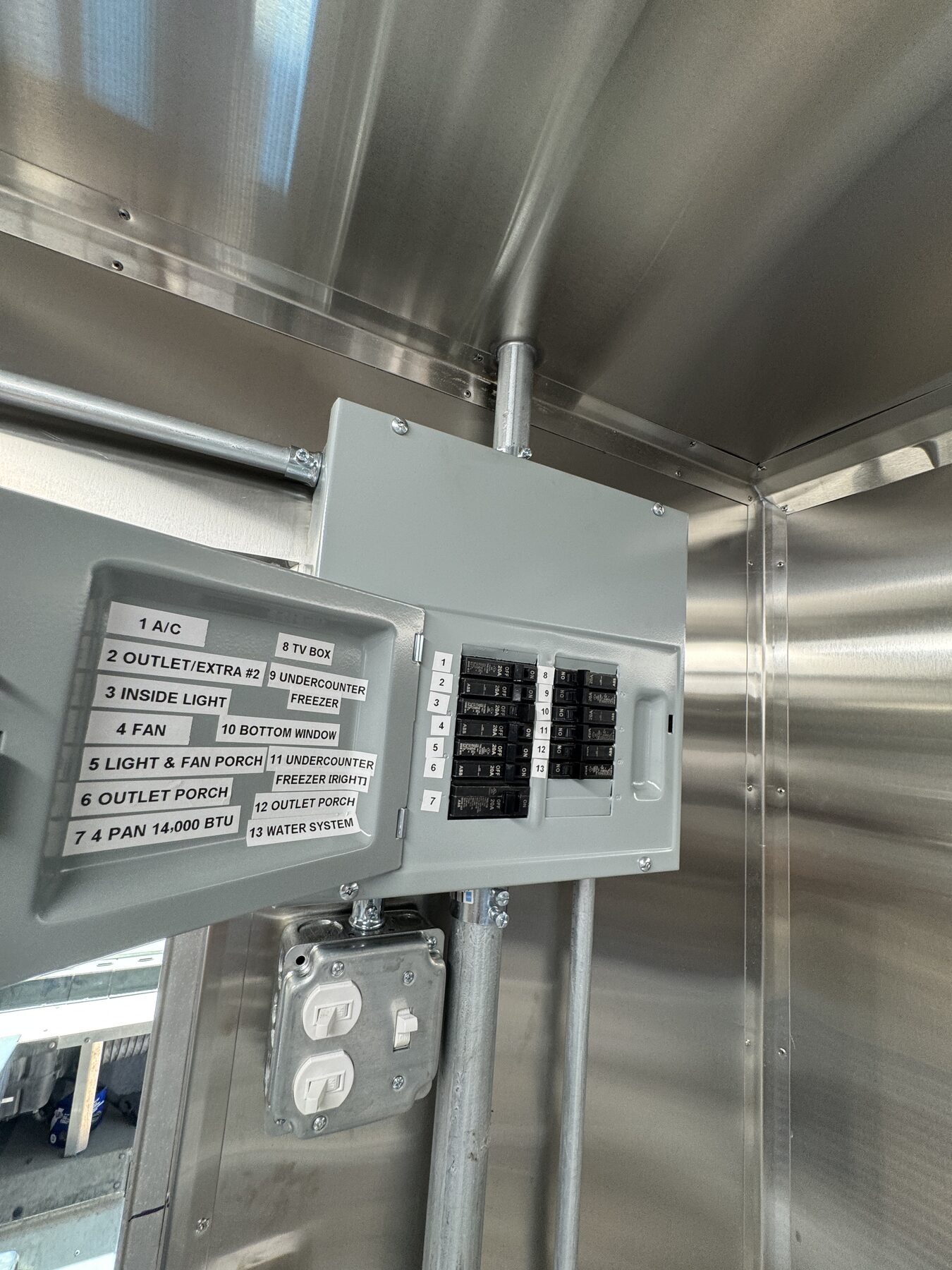
That label set is worth reading, because it is a map of the build. One is the air conditioning. Two is an extra outlet. Three and four are the inside light and the fan. Five, six and twelve belong to the porch. Seven is the steam table position. Eight is the television. Nine and eleven are the undercounter freezer. Ten is the bottom window. Thirteen is the water system. When something dies at a tailgate, the cook is reading a legend rather than opening every breaker in turn.
Off shore power the truck runs from a Westinghouse 12,500 watt dual fuel generator in an insulated box, with a propane line run to it so it can run on gas as well as petrol. The insulation is not for the generator, it is for the people standing six feet from it for eight hours.
The propane itself lives underbelly, in tanks slung beneath the floor and set forward of the rear so a shunt in a car park never reaches them. That is the standard on a truck, and it is one of the real differences between a truck and a trailer. A trailer has no chassis to hang tanks under, so the same gas goes into an external LP box on the tongue instead. It is worth knowing which one you are buying before your first inspection, because the inspector will be looking for the tanks in a different place depending on the answer, and so will whoever has to swap them at six in the morning.
Air conditioning is a heat pump rather than a cooling only unit. In Laramie that is a straightforward call. The town is at 7,200 feet, and a truck that works Jubilee Days in July also works a home game in November.
There is also a forty inch television frame, which sounds like a luxury and is not. A menu board that can be changed from a phone, on a menu where three items sell out before the end of service, is worth more than a printed board that has to be covered in tape by eight o’clock.
Building for 7,200 feet
Laramie sits at about 7,200 feet, which is high enough that it changes how the truck cooks.
Water boils around 199F rather than 212F, so anything simmered or braised takes materially longer. On a Jamaican menu that is most of the pot work: oxtail, curry goat, rice and peas. An operator moving up from lower altitude has to relearn their timings, and a steam table that is holding rather than finishing becomes more important, not less.
Gas appliances also behave differently at altitude. Combustion air is thinner, and manufacturers commonly specify altitude derating or different orifice sizing above a few thousand feet. With a 118,000 BTU range, an 80,000 BTU stock pot stove and a forty pound fryer on the same propane system, that is a conversation to have with the manufacturer for your specific appliances rather than something to assume, and it is worth having before the truck is delivered rather than during your first service.
Charcoal is the exception, and it is another quiet argument for the porch. A solid fuel fire is regulated by airflow, not by an orifice sized at sea level. The chimney flaps do at 7,200 feet what they do at two hundred.
Licensing a food truck in Laramie
Laramie is unusual in Wyoming, and it catches people out in a good way and a bad way at once.
The city runs its own environmental health office
Most of Wyoming licenses food establishments through the Wyoming Department of Agriculture, Consumer Health Services. Laramie has its own Environmental Health Division, on East Grand Avenue, and that is where the Food Service License comes from. The state inspector assigned to Albany County exists and is reachable, but the practical route for a truck operating in the city is the city office.
The fees match the statewide schedule: $200 for a new establishment, $100 a year to renew, and $50 for a temporary food licence, which covers 14 individual days within three consecutive months at a single location. Plan review is required before construction or remodelling under the Wyoming Food Safety Rule, and we could not find a published dollar figure for it, so ask when you submit.
On the build side, the Wyoming rule requires the waste tank to be 15 percent larger than the fresh water tank, sloped to a drain of at least an inch with a shut off valve, and a hand wash sink delivering at least 100F. It uses the term servicing area rather than commissary, defined as an operating base you return to for cleaning, waste discharge, water and stock. Hot water is a performance standard rather than a gallon figure: sufficient to meet peak demand.
There is no general business licence, but there is a mobile vending licence
Laramie does not have a general business licence at all, which surprises people. What it does have is a Mobile Vending Licence, issued by the City Manager’s Office on Ivinson Avenue under Chapter 5.82 of the municipal code. The only published figure we could find for it is $50, and that figure comes from a 2017 city bulletin, so treat it as indicative and confirm the current fee when you apply.
Parks are handled separately by Parks and Recreation. If you already hold the Mobile Vending Licence you do not need their vending licence, but you do still need a $25 vending permit for a specific date and location, and their season runs 1 May to 1 October.
Where you can and cannot set up
The rule that shapes a Laramie route is that vending is not permitted in the public right of way, with a narrow exception adjacent to park facilities. That pushes the work onto private property, events and permitted park pitches rather than street corners.
One live enforcement precedent is worth knowing. In 2023 the city revoked a mobile vending licence over greywater discharged into a storm drain, using its hazardous materials and oil release ordinance, with penalties of up to $750 a day for operating while suspended. Nobody plans to dump greywater in a storm drain, but people do get casual at the end of a long day at a busy pitch. Do not.
City staff have also discussed writing new food truck regulations, so if you are reading this some time after publication, check the current chapter rather than trusting any summary, including this one.
Fire
Wyoming adopted the 2024 International Fire Code, effective 28 June 2024, and Laramie adopts the most recent edition by reference, so the 2024 code applies in the city without local amendment to either the mobile food vehicle section or the solid fuel provisions. We could not find a published Laramie fee for a mobile food vehicle fire inspection, so budget for it as an unknown and call Code Administration.
Where a Jamaican truck earns in Laramie
Laramie has about 32,300 people and the University of Wyoming has about 10,800 students. That student number is the one to build a week around. It is a third of the town, it turns over every autumn, and it is a demographic that has usually never had proper jerk chicken and will tell its friends when it does.
Food trucks work the Tailgate Park by the Indoor Practice Facility at Cowboys home games, which is the single biggest concentrated opportunity in the calendar. Most of the other tailgate lots are bring your own, so that park is where the trade is. It is also where an open porch with a smoker on it stops being a build decision and becomes marketing, because the smell carries across a car park in a way a printed board never will.
Laramie Jubilee Days runs 4 to 12 July in 2026, nine days over the Independence Day week, and it is the town’s biggest event. The Laramie Farmers Market runs Friday afternoons from late June to late September in the lot north of Depot Park, skipping the Jubilee Days weekend, and it has a prepared food category. Neither publishes a vendor fee, so both are phone calls.
The competitive picture is the interesting part. We could not find a single Jamaican or Caribbean restaurant or truck operating in Laramie or Albany County. The nearest we found is in Cheyenne, which is fifty miles east and, despite the name, in a different county. For a concept that depends on being the only one doing it properly, that is close to an open field.
What a build like this costs
Custom food trucks start at $55,000 and custom food trailers start at $40,000. A typical 16ft truck comes in around $72,000 and a 22ft around $110,000, so a twenty foot body sits between those before anything unusual is added.
This one is not a plain twenty foot build. Converting the back six feet into an open porch, hanging a canopy and a dedicated exhaust fan over a solid fuel appliance, fitting an RV door between the porch and the kitchen and running a separate lighting and power zone out there are all fabrication rather than catalogue parts. So is a self closing three section window. Every one of those adds to a straight twenty foot number.
Build time is about six weeks from order. On this one the long pole was not equipment, it was agreeing the porch, the smoker exhaust and the door, which is exactly the sort of thing worth spending an extra week on at the drawing stage.
Frequently asked questions
Can you put a charcoal grill on a food truck?
Yes, and it is usually better outside the kitchen than inside it. On this build the back six feet of a twenty foot body was left open as a porch and the smoker stands in it under its own canopy and fan. That keeps the heat, the smoke and the ash out of the kitchen and gives the appliance an exhaust path of its own. The fire code requires a solid fuel appliance to exhaust through a system independent of any other exhaust, so it should never share ducting with your gas hood. Whether your fire authority reviews it under the commercial kitchen hood rules or as outdoor cooking equipment is a local determination, so get it agreed before fabrication.
What is a food truck porch?
It is a section at the back of the body left open, with no floor cabinets and no rear wall, so live fire equipment can sit outside the kitchen while still travelling with the truck. On this twenty foot build the porch is six feet deep, carries a sixty inch charcoal smoker under a stainless canopy with its own exhaust fan, and connects to the kitchen through an RV door with a window in it. It has its own light, fan and two outlets on the panel.
Where do the propane tanks go on a food truck?
Underbelly. On a truck the LP tanks are slung beneath the floor and set forward of the rear of the vehicle, so a low speed impact from behind cannot reach them. A trailer is different, because there is no chassis to hang tanks under, so a trailer carries its propane in an external LP box on the tongue. On this build the underbelly tanks feed the range, the fryer and the stock pot stove, and a separate line runs to the generator so it can run on propane as well as petrol.
Does the fire code cover charcoal on a mobile food unit?
Not directly. The section written for mobile food preparation vehicles addresses grease laden vapours, hoods, suppression, LP gas and cooking oil, and does not mention solid fuel at all. Solid fuel is dealt with in the commercial kitchen hood provisions, which were written for buildings. That gap is why the fire code official’s judgement decides the outcome on a truck.
Who licenses a food truck in Laramie, Wyoming?
The City of Laramie Environmental Health Division issues the Food Service License, at $200 for a new establishment and $100 a year to renew, with a $50 temporary licence available. Separately the City Manager’s Office issues a Mobile Vending Licence under municipal code chapter 5.82. Note that Laramie has no general business licence.
Can I park a food truck on the street in Laramie?
Generally no. Vending is not permitted in the public right of way, with a narrow exception for areas adjacent to park facilities. Private property, permitted park pitches and events are the workable options, and a park pitch needs a $25 vending permit for the specific date and location.
Does altitude change how a food truck cooks?
At Laramie’s 7,200 feet, yes. Water boils around 199F instead of 212F, so simmered and braised dishes take longer, which matters on a menu built around oxtail, curry and rice and peas. Gas appliances may also need altitude derating or different orifice sizing, so check the manufacturer’s specification for your range and fryer rather than assuming. Charcoal is the exception, because a solid fuel fire is regulated by airflow rather than by an orifice.
How long does a build like this take?
About six weeks from order. Custom fabrication such as an open rear porch, a dedicated smoker exhaust and an RV door between the porch and the kitchen is agreed at the drawing stage, and that conversation is worth taking time over because it is the part that cannot be changed later.
More reading
- Food truck permits in Wyoming
- Custom food trucks in Laramie, Wyoming
- Running a food truck at high altitude
- Custom food trucks in Cheyenne, Wyoming
If you are working out whether your concept needs live fire and where to put it, call or text and we will go through the smoker, the exhaust and the fire conversation before anything gets drawn. We have built around 500 food trucks, trailers, bus conversions and van conversions, and we deliver across Wyoming and Colorado.
Jacob Varghese
Mile High Foodtrucks
720-209-2653
Recent Comments