
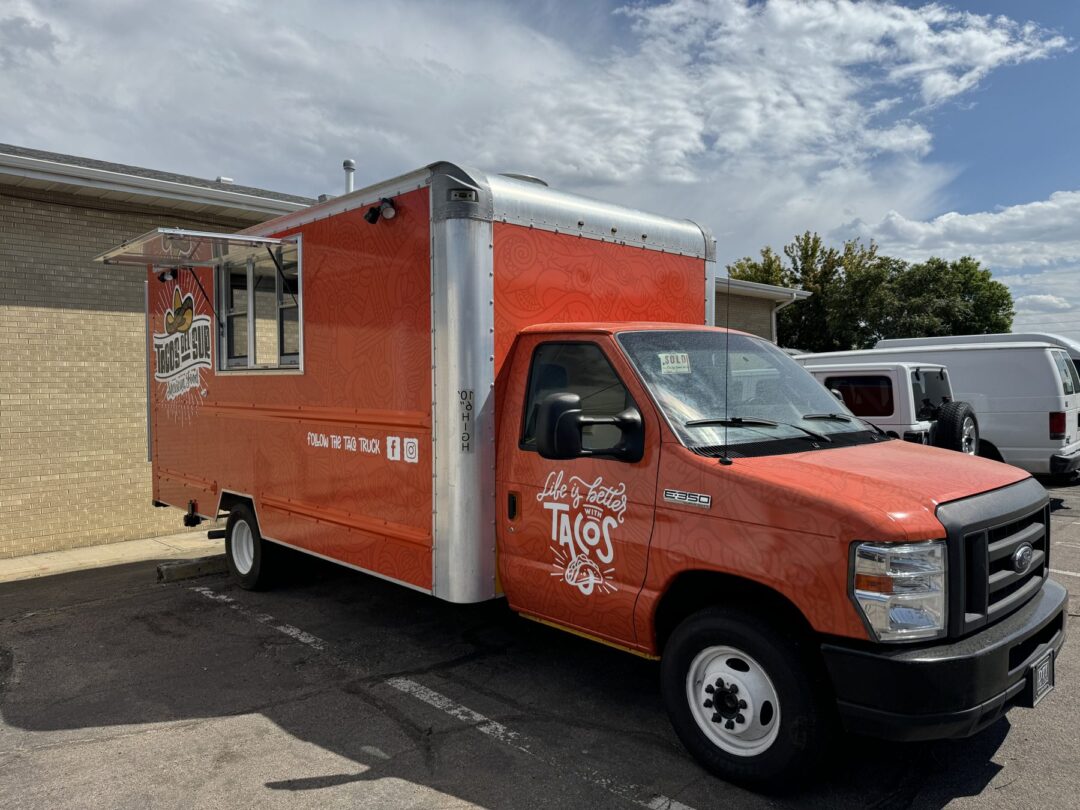
Tacos del Sur cooks authentic southern Mexican food in Aurora, and much of their week is catering: weddings, birthdays, graduations and company events. They also trade over in Lakewood. The truck they brought to our Denver shop was not the step van we usually start from. It was a used fleet box truck, a 2019 Ford E350 carrying a 16ft box, with just over 100,000 miles on the clock.
What they needed the truck to do
Catering means volume. The owners needed a long flat top that could take a crowd, toppings close at hand, and a place to keep cooked meat hot between orders.
The 16ft box itself was a good fit for that. Inside, it is one tall, square room, and nothing intrudes from the wheels, so a straight cook line drops right in. The catch is that a box truck arrives with three things a step van does not, and each had to be sorted out first.
Soft walls. The box is built from FRP, meaning plywood faced with fiberglass. That is fine for freight, but the skin cannot carry hanging weight, and this line includes a 294 pound griddle, a hood and a refrigerated base. We framed out the interior and fixed all of the equipment to that new structure.
A roll up shutter. Shutters leak air and dust, and an inspector will not sign off on one as the way into a kitchen. Ours came out. We framed the hole and hung an RV door with a screen.
No pass through. The cab and the box are separate, so the kitchen is a closed room whose only entrance is that rear door. A good seal there pays off in an Aurora winter: less heating, less condensation on the stainless, and no cold draft at the window.
How we laid it out
The heart of the truck is an Atosa ATMG-48. That is 48 inches of countertop griddle, four 30,000 BTU burners for 120,000 BTU in all, under a polished steel plate three quarters of an inch thick. On a taco line the plate matters more than the burners. Heavy steel stays hot when a whole tray of cold protein lands on it during the rush.
To its side sits an Atosa ACHP-2-LP, a 12 inch, two burner hotplate rated at 64,000 BTU. Beans, rice and salsa roja get cooked here in pots.
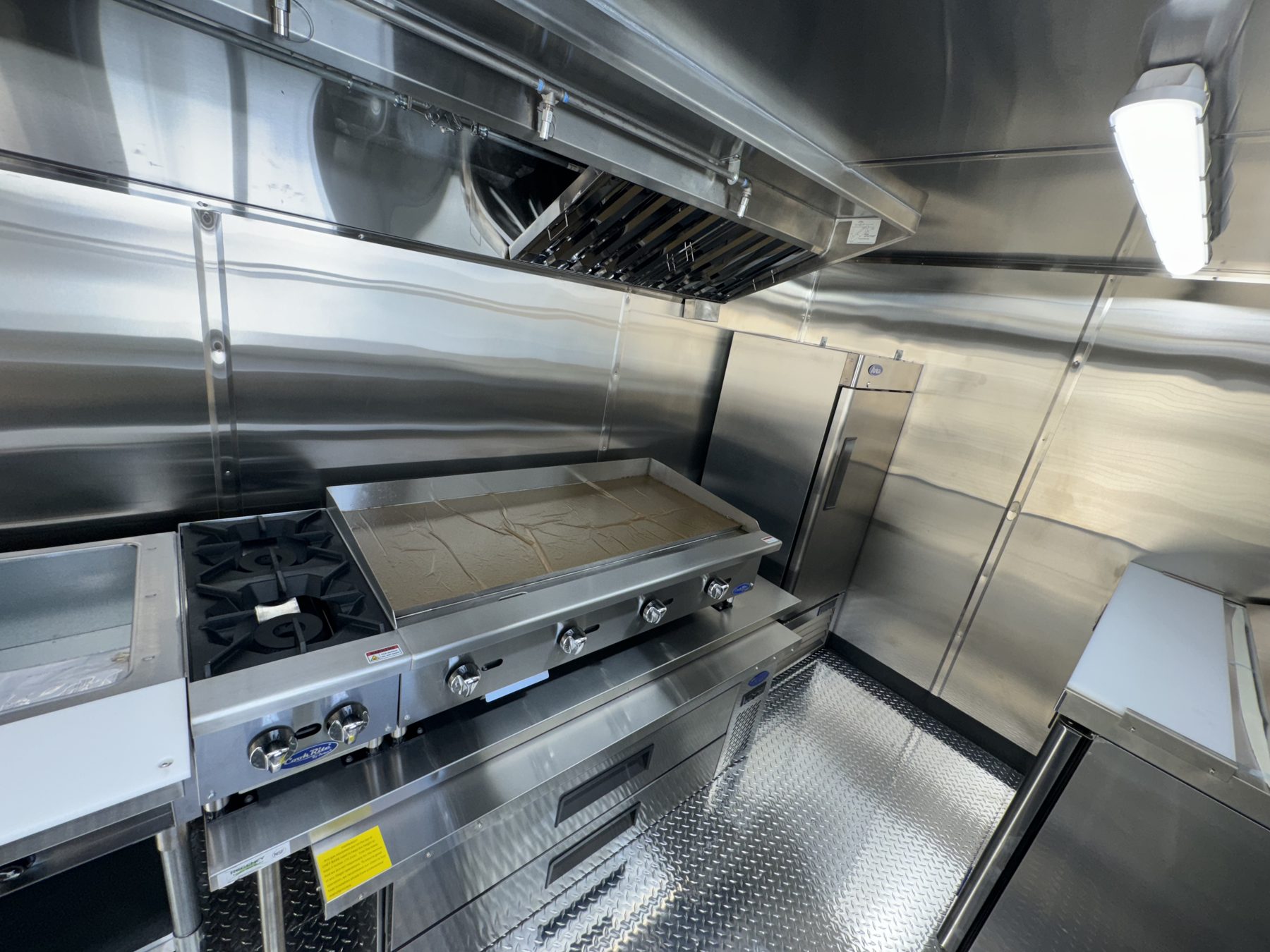
Underneath both is an Atosa MGF8452GR refrigerated chef base. Its extended top is 60 and a half inches of reinforced stainless, and 48 inches of griddle plus 12 of hotplate comes to 60, so it all fits on one base.
Further along is an Eagle Group HT3, a three pan steam table running on propane at 10,500 BTU, with an 8 inch cutting board on the front edge for anything that is held rather than cooked to order.
Across the aisle, on the window side, is the cold prep. An Atosa MSF8302GR sandwich and salad table, 48 inches long and 13.4 cubic feet, holds twelve sixth size pans for onion, cilantro, limes, salsas and the rest. An Atosa MBF8519GR low height reach in, 8.3 cubic feet, adds storage. The three compartment sink and the hand sink share that wall.
Orders go out through a 5ft window of tempered glass that closes on its own. On the service table under it, we turned the shelves over so cups and ticket boxes cannot slide off on the road.
Hood, propane, power and water
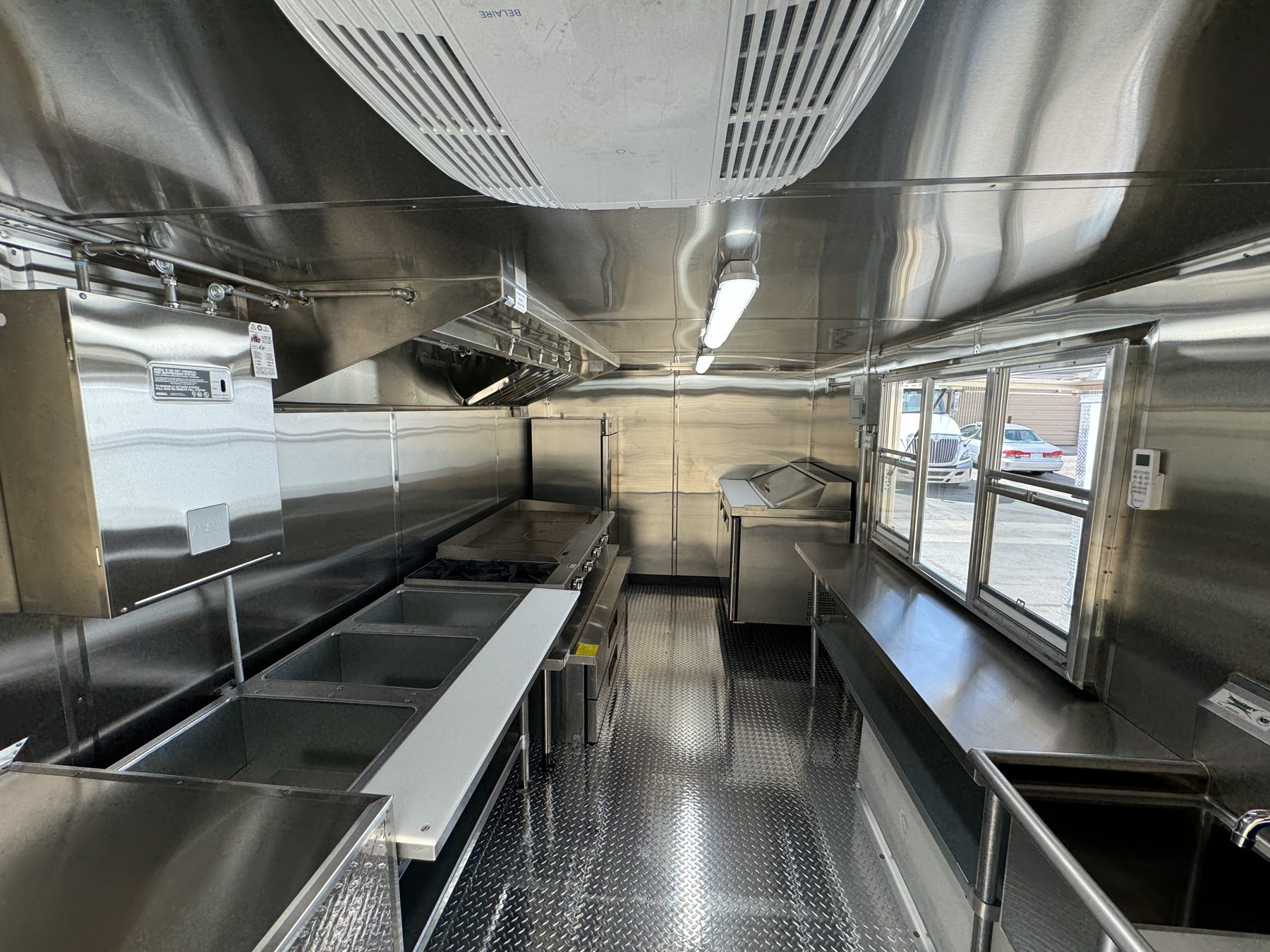
Hood and suppression. An 8ft hood covers the line, pulled by a 1,650 CFM fan on the roof. Certified installers fitted ANSUL wet chemical suppression, and there are ABC and Class K extinguishers on board.
We made that hood longer than the current equipment needs. It runs past the griddle and hotplate to cover the steam table as well. The steam table could live without it, but if Tacos del Sur ever trades it for a fryer or a second griddle, they will not need to add duct, redesign the suppression or go through another fire inspection to do it.
For airflow, the light duty rate in the model mechanical code works out to 1,600 CFM for an 8ft hood, and this fan is rated for 1,650. The hood maker’s rating and Aurora Fire Rescue still have the final say. Our food truck compliance services cover this kind of hood and suppression work.
Propane. Every burner on this truck runs on propane, fed from two tanks slung under the chassis. On our trucks the propane always rides underneath, ahead of the rear bumper, out of reach of a rear end bump.
Power. When there is no hookup, a 9,500 watt generator in its own box takes over, and the lid of that box gives the crew extra counter space. With all the cooking on gas, the electrical side only has to run the refrigeration, lights, fan and air conditioner. The three cold units pull under 7 amps combined. The 125 amp panel has a labeled breaker for each load, with all wiring in conduit: fridge, chef base, sandwich prep, window outlet, air conditioning, outlet, lights, fan and water system.
Water. Fresh water comes from a 40 gallon tank through a pump and water heater, and the sinks drain into a 50 gallon waste tank. Colorado wants the waste side at least 15 percent larger, and this setup clears it. The fresh tank is bolted through the floor with washers. Forty gallons weighs over 330 pounds, and if it shifts under hard braking, it tears the plumbing loose. Fill and drain fittings are on the outside of the box.
Finish. Stainless covers the walls and ceiling, with half inch plywood and an inch of insulation behind it. The floor is aluminum diamond plate, LED strips light the full length of the griddle, and a rooftop air conditioner keeps summer bearable.
Getting it licensed in Aurora
Aurora stretches across Arapahoe, Adams and Douglas counties, and the health license comes from your county, not the city. So start by working out which county you belong to.
Health. Since Tri-County Health was dissolved at the end of 2022, each of the three counties has run its own health department. The one you deal with depends on your base and your commissary location. Every one of them wants a plan review for a new mobile unit and a commissary agreement in writing. If you are in Adams County, note two things: licenses there run out every December 31, and your commissary has to be in Adams County too. Check that before you sign for a kitchen across the line in Denver.
City. Aurora handles its own sales tax, and the City of Aurora business license is what lets you collect it.
Where you can set up is spelled out in the city’s mobile food guidance. Stay out of residential zones and at least 50 feet from any single family home. Keep 175 feet from an open restaurant unless the restaurant agrees in writing. On private land, get the owner’s written OK. On city land, you need a temporary use permit or a vendor agreement, and parks and schools take special permission. Trading hours are 7am to 10pm. In the public right of way, skip the tables, the fixed setups and the speakers.
Fire. Aurora Fire Rescue permits any mobile food vehicle that gives off smoke or grease laden vapor, so a griddle truck needs one. The city currently uses the 2021 International Fire Code.
Other cities. HB 25-1295, in force since January 1, 2026, allows one Colorado jurisdiction’s fire safety permit to be honored in another, provided the issuer is on the latest fire code, a certified inspector signed off, and you give 14 days notice. Denver retail food licenses now count as state licenses as well. Aurora is still on the 2021 code, so call ahead before relying on an Aurora permit elsewhere. Lakewood is a live example for this truck: it is in Jefferson County and served by West Metro Fire Rescue, so both cities need checking before the first service there.
We build for Aurora and the rest of the metro from our shop, and our Denver food truck builder page covers the area.
If you are planning something similar
Count the box work when you price a used box truck. Internal framing and a real rear door are extra steps a step van skips.
Buy hood length for the menu you may grow into. Covering an extra station now spares you new duct, new suppression design and a new inspection later.
Pick your county and commissary as a pair. In Aurora, your base decides your health department, and Adams County insists the commissary be local.
Questions we get about this build
Can a box truck be turned into a food truck?
Yes. This one began as a 2019 Ford E350 with a 16ft box. You get a tall, square kitchen with no wheel wells in the way. In exchange, you have to frame the inside of the fiberglass and plywood box to carry heavy equipment, replace the roll up shutter with a sealed door, and accept that there is no walk through from the cab.
What griddle does this taco truck run?
An Atosa ATMG-48: 48 inches wide, four 30,000 BTU burners and a plate three quarters of an inch thick. A 12 inch two burner hotplate sits beside it for anything cooked in a pot.
Who licenses a food truck in Aurora?
Your county health department, which is Arapahoe, Adams or Douglas depending on your base, after a plan review and with a written commissary agreement. You also need a City of Aurora business license for sales tax, and an Aurora Fire Rescue permit if the truck makes smoke or grease laden vapor.
Where are food trucks allowed to park in Aurora?
Private property with written permission from the owner, or city property with a temporary use permit or vendor agreement. Residential zones are off limits, as is anywhere within 50 feet of a single family home or within 175 feet of an open restaurant that has not agreed in writing. Hours run from 7am to 10pm.
Planning your own line? Look through finished builds in our gallery, then send your menu through the quote form or call the Denver shop at 720-209-2653. You can find us at 3895 E 45th Ave Suite E, building for owners across the Front Range and beyond.
Planning a build like this?
Tell us what you want to cook and where you will park. We will send a layout and a written quote.
Get a free quoteCall 720-209-2653
Recent Comments