
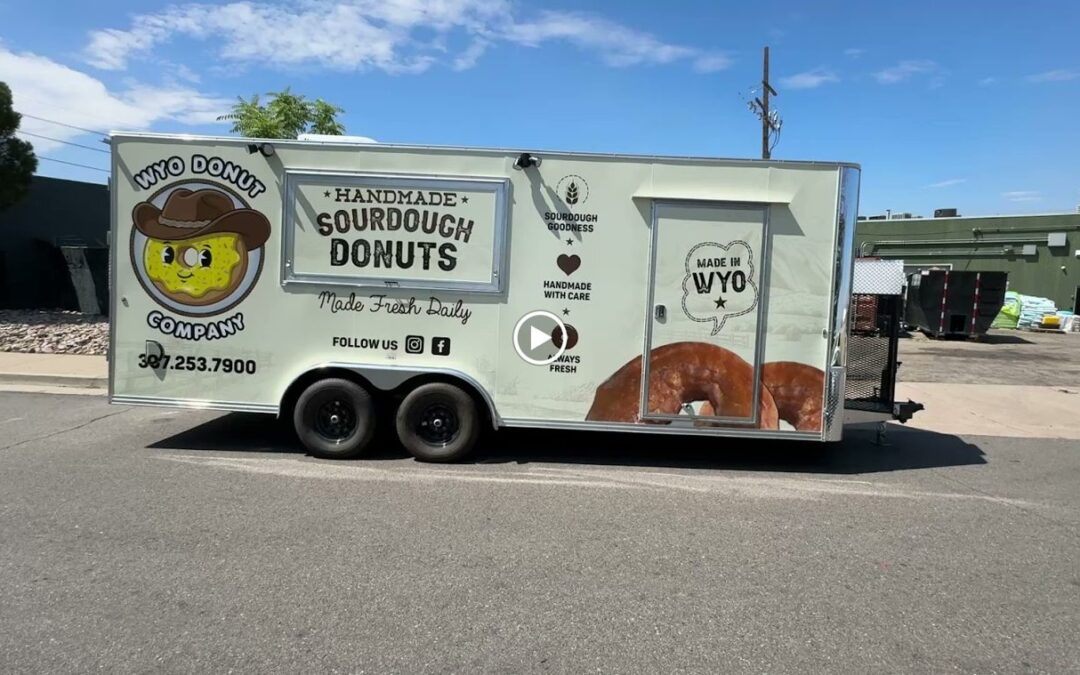
A donut shop washes more than it fries. That is the thing nobody tells you before you build one, and it is why the single most important piece of equipment on this trailer is not the fryer. It is the twenty gallon water heater under the counter.
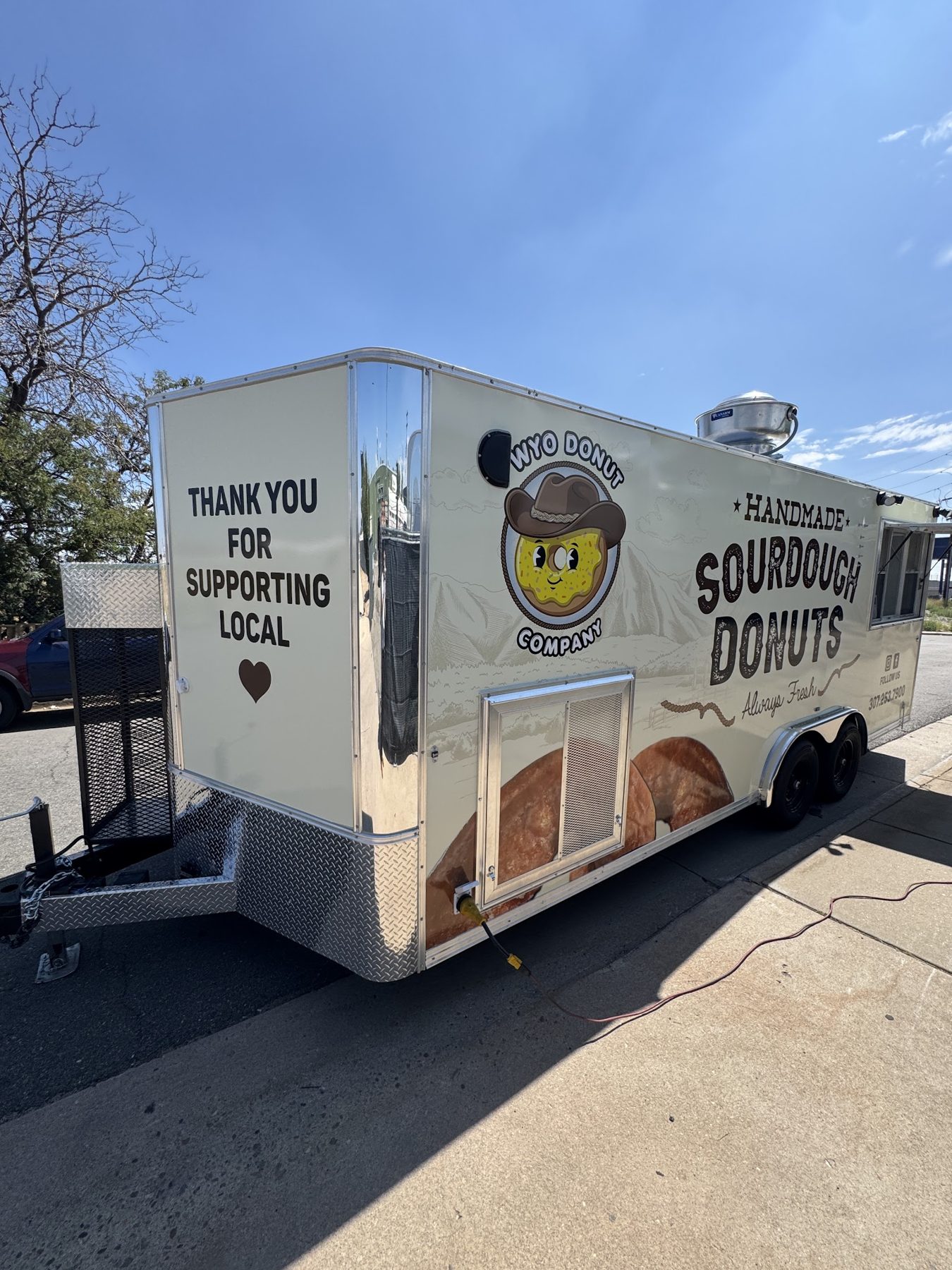
Sugar glaze sets on a sheet pan in about ten minutes. Sourdough dough dries onto a mixer bowl faster than that. Every tray, every bowl, every cutter and every dough hook in a donut kitchen comes to the three compartment sink coated in something that only hot water will move, and a standard trailer heater holds six to eight gallons. On a busy Saturday that is one sink fill. So when Wyo Donut Company came to us for a trailer to run sourdough donuts in Casper, Wyoming, the first thing we changed from a standard build was the hot water, and most of the other decisions followed from thinking about the trailer as a small bakery rather than a small restaurant.
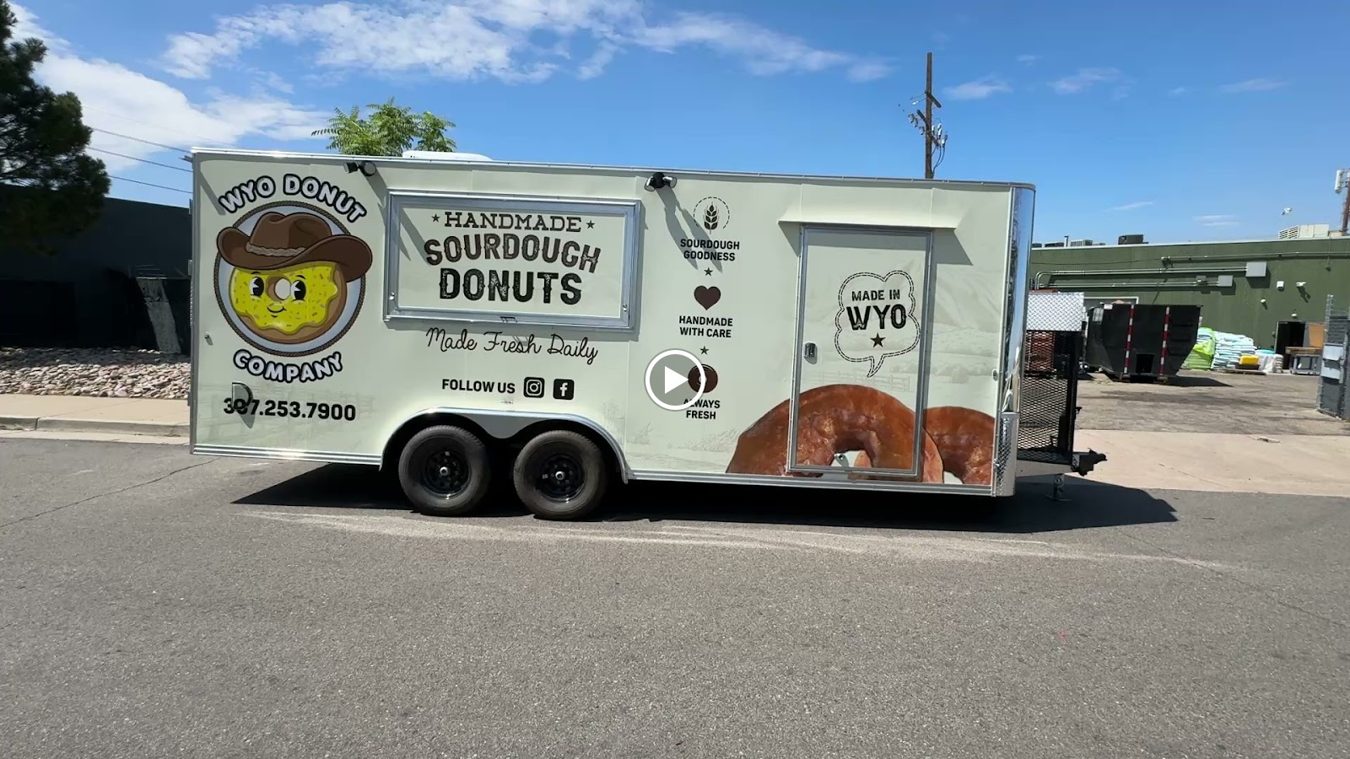
Wyo Donut Company makes handmade sourdough donuts, which is a different product from the cake and yeast donuts most shops sell. Sourdough is slow. The dough is mixed, rested, shaped and proofed over hours, and it is sensitive to temperature in a way a mix from a bag is not. That is the other reason this trailer is laid out the way it is: the proofing cabinet is as important as the fryer, and both of them had to fit on one side of a twenty foot box with the windows on the other.
A bakery line in twenty feet
The trailer is an eight by seven by twenty foot seamless enclosed box on a tandem axle. Inside it has FRP walls and ceiling, which wipe clean and do not hold flour dust, and a diamond plate floor. Behind the walls is the heavier insulation and plywood package we fit on trailers that are going to work through a Wyoming winter, which is covered further down.
The kitchen is organized as a line, because donut production is a line. Dough comes out of the mixer at the front of the cook line, goes into the proofing cabinet beside it, comes out of the proofer onto the table, goes into the fryer, and comes out of the fryer onto the table under the window to be glazed and boxed. Nobody has to walk the length of the trailer carrying a tray of proofed dough, and the person at the window never has to reach across the fryer. Five stainless work tables and three wall shelves give the dough somewhere to rest at every stage.
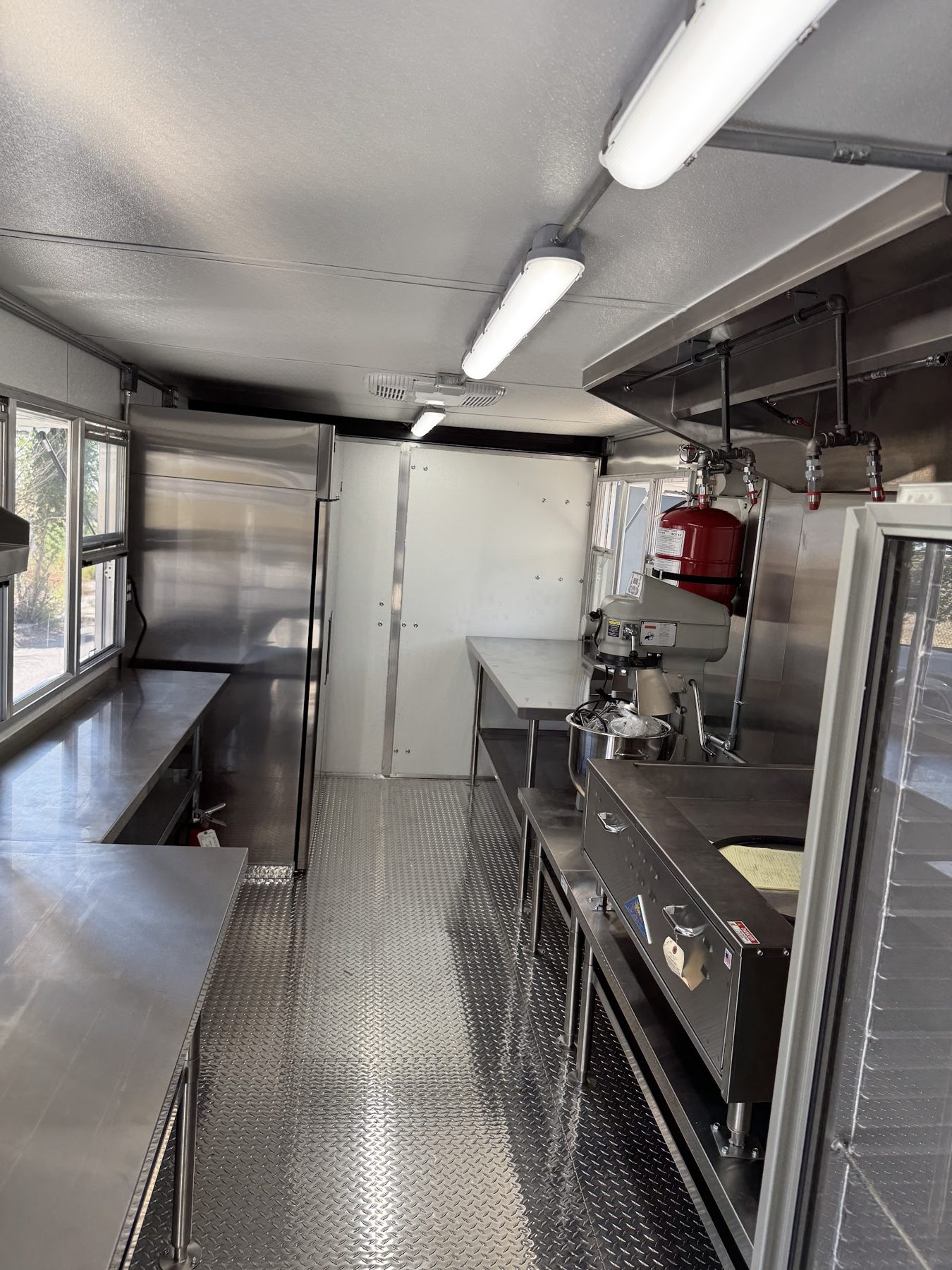
The fryer is a flat donut fryer rather than a basket fryer, which is the right tool for the job: donuts float, they are turned once with sticks, and they need a wide shallow bath rather than a deep one. The mixer beside it is a floor standing commercial stand mixer. The fryer and the mixer were supplied by the owner, which is common on specialty builds where the operator already knows exactly which model they want, and we laid out the gas line, the hood and the outlets around them.
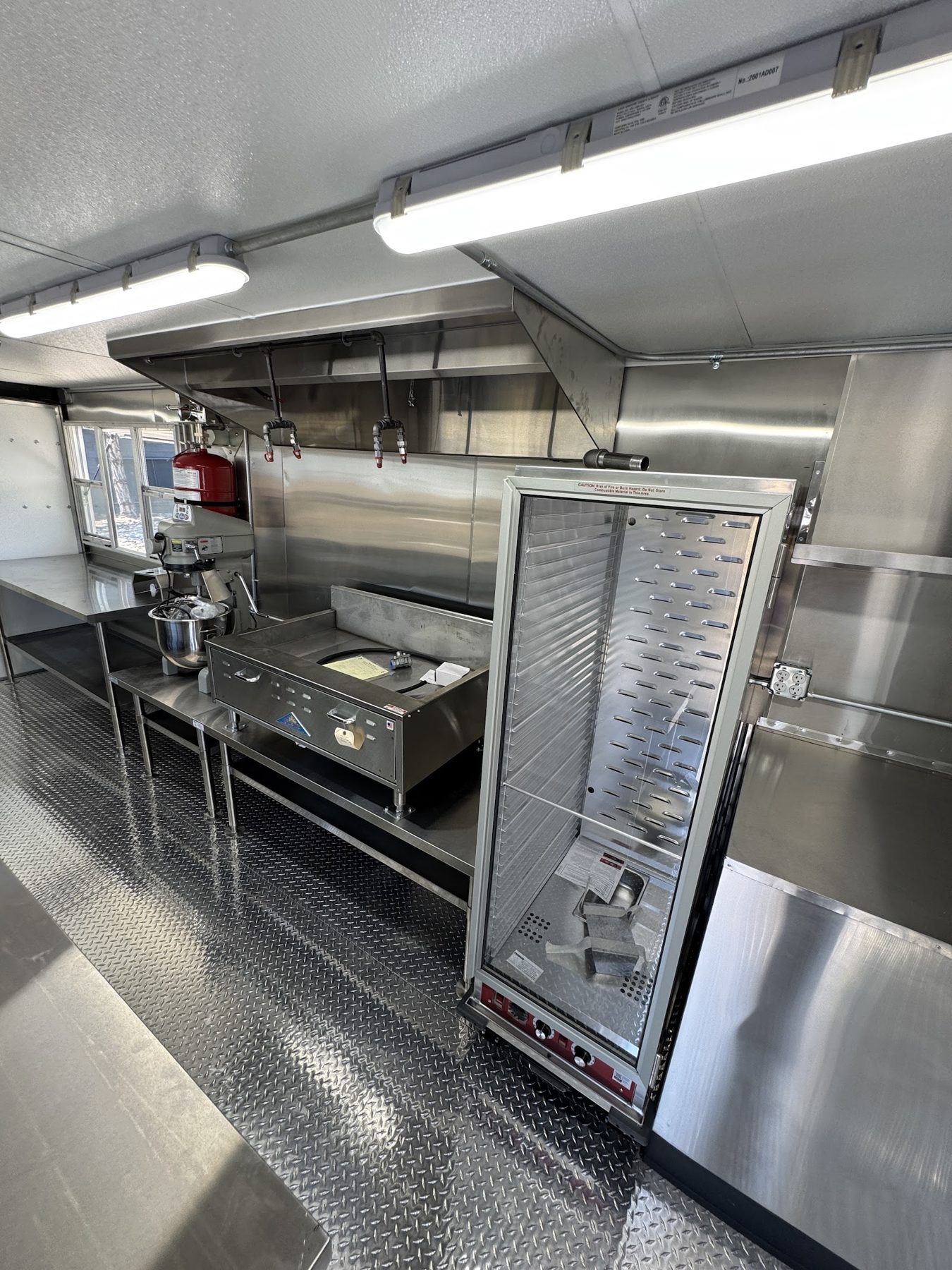
The proofing cabinet sits on casters at the end of the cook line. A proofer is a tall insulated box that holds dough at a warm, humid, controlled temperature so it rises evenly, and in a trailer it has to do that whether it is fifteen degrees outside or ninety five. It needs a dedicated outlet, enough clearance to open the door fully with a sheet pan in your hands, and a way to secure it for the tow. On this build it rolls out for cleaning and parks against the wall with the door facing the table.
The hood and the fire system
A donut fryer is still a fryer. It produces grease laden vapor, and it has a bath of hot oil that can catch fire, so it sits under a six foot Type 1 hood with an automatic wet chemical suppression system. The suppression system was installed by a licensed fire protection company, which is the only way we do it, because the inspector who checks the trailer in Casper wants to see a tag from a licensed installer on the cylinder, not a tag from a trailer builder.
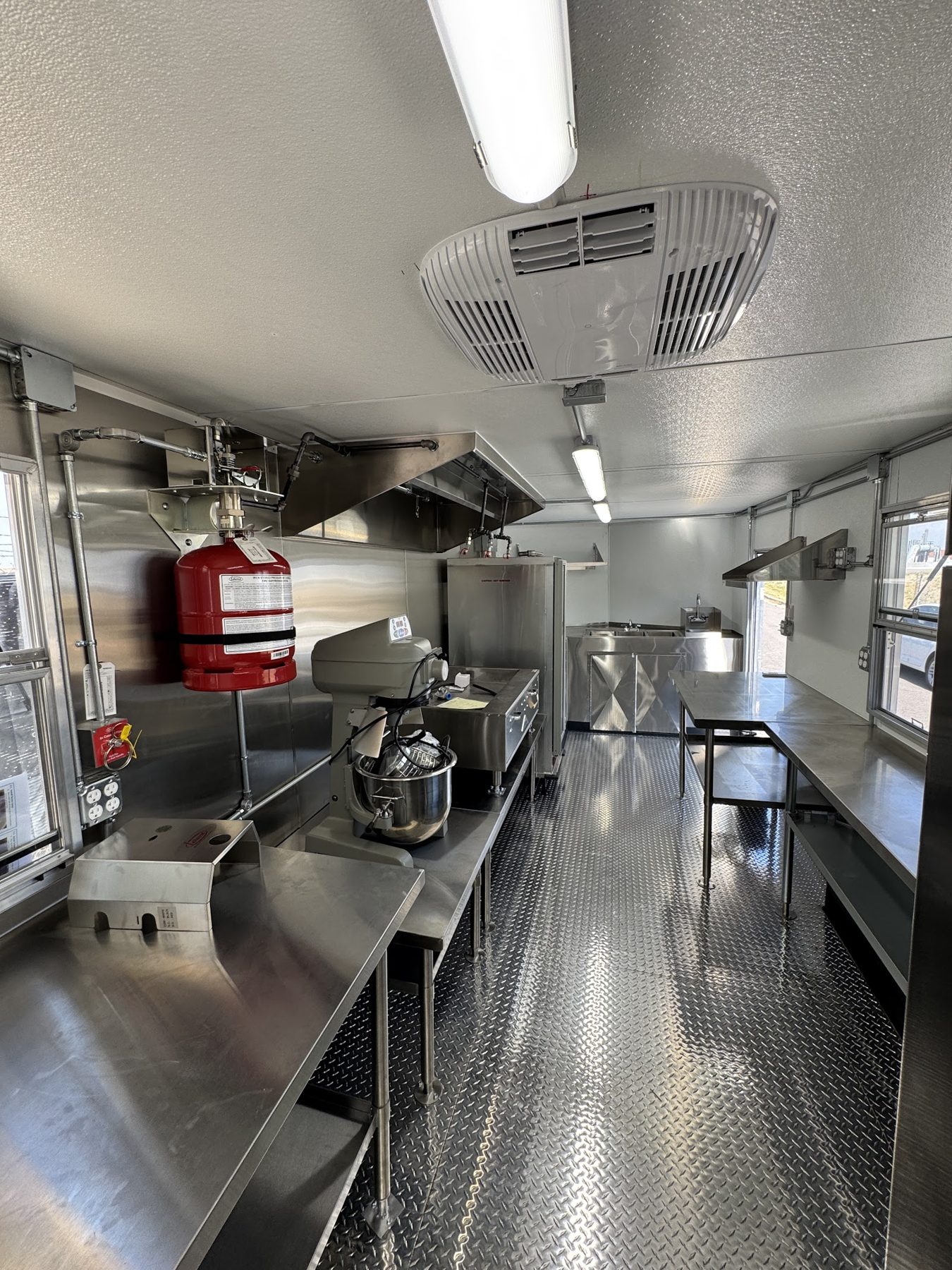
The hood on this trailer was built to NSF standards and to the Colorado requirements we build to on every unit, which are at least as strict as Wyoming’s. A six foot hood over a fryer and a mixer is more hood than the fryer alone needs, and that is deliberate: it gives the owner room to add a second fryer or a small griddle later without rebuilding the hood, the duct and the suppression layout, and it keeps the air in a small enclosed kitchen clear when the fryer has been running for four hours.
Water, and why there is so much of it
This is the part of the build that departs furthest from standard. The trailer carries a thirty gallon fresh tank and a forty gallon grey tank, with the grey tank larger than the fresh tank so the sinks never back up before the fresh water runs out. Between them is a twenty gallon water heater and a pump.
Twenty gallons of hot water is roughly three times what a standard trailer carries. The reason is the three compartment sink. In a burger trailer the sink is filled once or twice a shift. In a donut trailer the wash compartment is emptied and refilled every time it fills with dissolved glaze, and that happens a lot. A small heater recovers slowly, so by the third fill the water is lukewarm, the glaze stops dissolving and the dishes pile up. A twenty gallon heater means the sink can be refilled hot three times in a row without waiting.
The hand sink is separate, with its own hot and cold supply, which the health department requires. Both sinks drain to the grey tank, and the fresh tank fill and the grey tank drain are on the outside of the trailer so neither job means carrying anything through the kitchen.
Two windows, one awning
The service side has two windows: a six foot by three foot window and a five foot window, with a six foot outdoor shelf under the second one. On most trailers we fit one window. On a donut trailer two make sense, because the business is a morning rush. Donuts are bought on the way to work, before a game, after church, and the queue is long for an hour and gone by ten. The second window lets the owner run an order lane and a pickup lane, or open the shelf window for pre boxed dozens and keep the main window for people choosing one at a time.
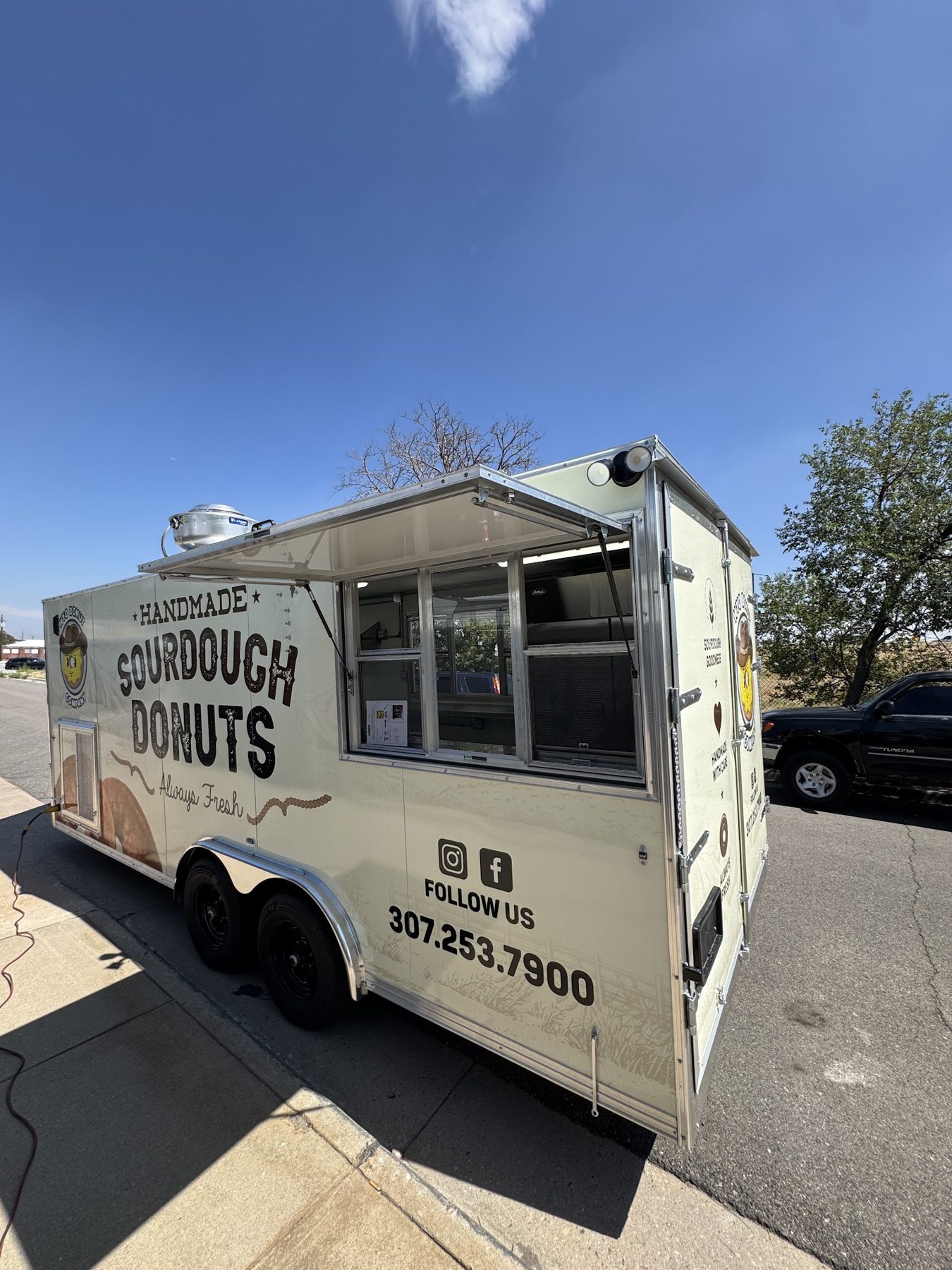
The windows are concession style with the glass lifting up to form an awning, which matters in Casper for a reason that has nothing to do with rain: the wind. Casper averages wind speeds well above most of the country and gusts of thirty or forty miles an hour are an ordinary day, so a window that opens outward and latches is a window that stays open.
Cold, power and the heavier wall package
Casper sits at about 5,300 feet in central Wyoming. The average low in January is around fifteen degrees, the city sees over seventy inches of snow in a typical winter, and the record lows are in the minus forties. A trailer built for Arizona does not survive that. This one has the thicker wall insulation and heavier plywood backing that we fit on cold climate builds, a rooftop air conditioner with a heat strip so the kitchen can be warmed before the fryer comes up to temperature in the morning, and interior and exterior lights, two of each, for the dark mornings a donut business lives in.
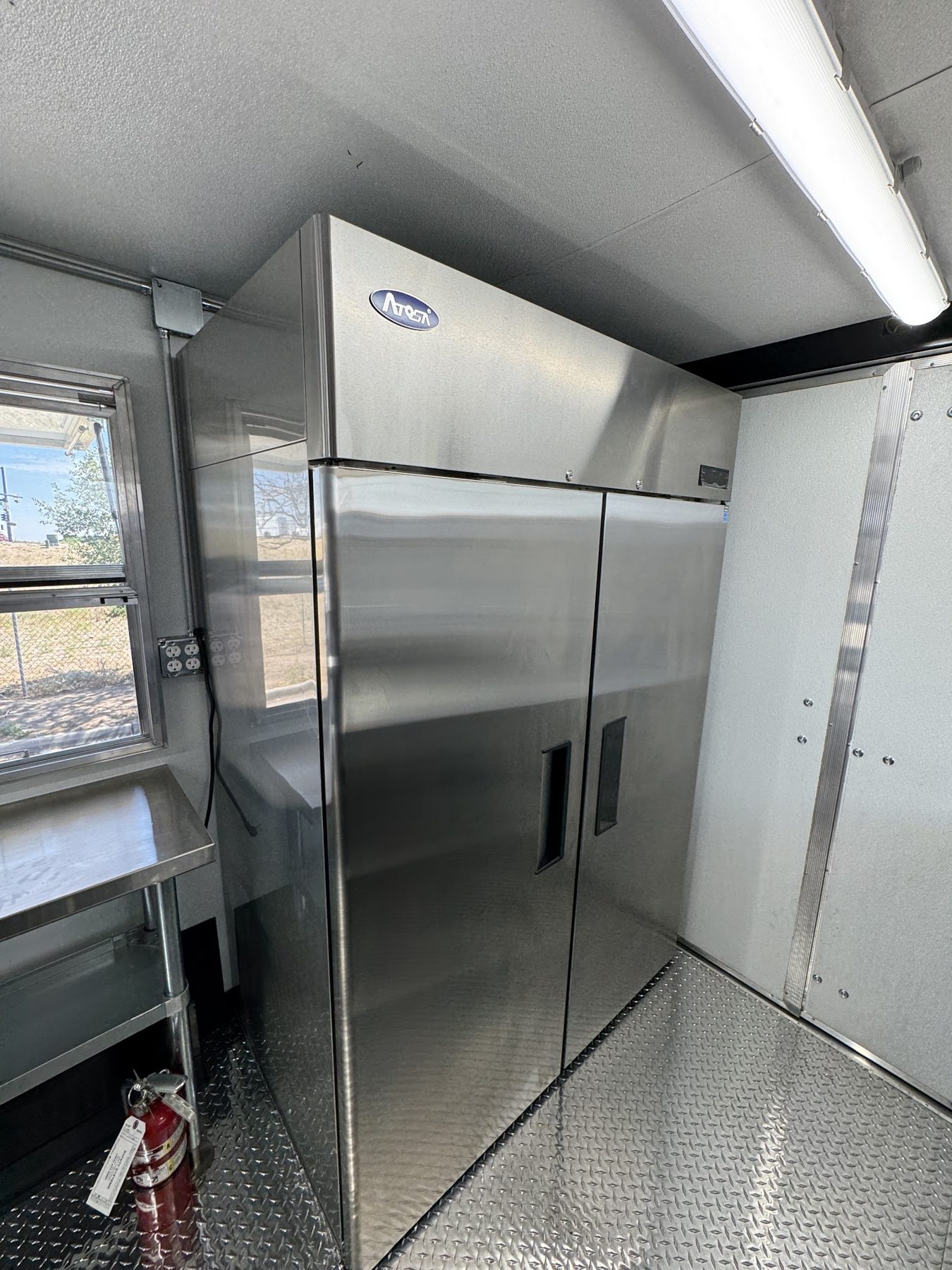
Cold storage is an Atosa MBF8005GR two door reach in at the back of the kitchen. For a sourdough operation the fridge is not just for dairy. It is where the dough retards overnight, and a two door unit gives enough shelf space to hold full sheet pans of shaped dough flat, which a single door reach in does not. It sits at the far end from the fryer so it is not fighting the heat from the cook line.
Power comes from a Westinghouse 12,500 watt dual fuel generator mounted in a generator box rather than out on the tongue. A box keeps the generator dry, quiet and attached to the trailer, and a dual fuel unit can run on propane from the same supply as the fryer or on gasoline, whichever is easier to get at an event. The panel is 125 amps with twelve outlets, which is more than a donut kitchen needs today and is there so the owner can add a glazer, a second proofer or a display case without an electrician.
Licensing a food trailer in Casper
Wyoming is one of the simpler states to license a mobile food unit in, but it is not one agency. Here is how it works for a trailer based in Casper, as of this writing. Fees change, so confirm them with the offices named before you budget.
Health: Casper Natrona County
The Casper Natrona County Health Department handles plan review and inspection of mobile food units in the county. Plan review is a flat fee of around $125, and the physical inspection of the unit is around $60. They want to see the water system, the sinks, the refrigeration, the hood and the general construction, which is why we photograph every stage of a build and send the owner a spec sheet to submit with the plans. A trailer like this one that is fully self contained, with its own fresh water, waste, hot water, three compartment sink and hand sink, passes that review without a commissary agreement.
The state food licence
The licence itself comes from the Wyoming Department of Agriculture under the Wyoming Food Safety Rule. A new mobile food licence is around $200 and the annual renewal is around $100. Once licensed, the unit is inspected roughly twice a year. The useful detail for Casper operators is that a self contained unit can be licensed on its own, but a unit that depends on a commissary for water, waste or storage is tied to that commissary and cannot work outside Natrona County. If you want to take the trailer to Douglas, Riverton or Cheyenne for an event, build it self contained.
The city
The city of Casper does not require a separate health licence or a general business licence for a mobile food unit. What it does run is the Mobile Vendor Permit Program for vending on public property in the downtown and Old Yellowstone districts, at around $25 per space per day, with the fee waived in city parks. Private property is between you and the property owner. Sales tax in Natrona County is five percent from October 2026, collected through the state.
Fire
Casper has adopted the 2024 International Fire Code, and the fire department inspects mobile food units before they operate: the propane system, the hood and suppression system, the tag on the cylinder and the extinguisher. There is no published fee for that inspection at the moment. Everything the fire inspector looks for on this trailer was installed by a licensed company and photographed, so the inspection is a check rather than a negotiation.
Where a donut trailer earns in Casper
Casper is a city of about 59,000 people and the commercial center for a much larger area of central Wyoming, with a median household income around $70,000. It has a handful of established donut shops, which tells you two things: people in Casper buy donuts, and nobody is selling sourdough. A product that is different from everything else in town, sold from a trailer that can go to where the morning crowd already is, does not have to compete on the same corner as the shops.
The event calendar is strong for a morning product. The Central Wyoming Fair and Rodeo runs over a week in July, 5150′ Fest fills David Street Station in August, and the downtown farmers market, high school sports, the college and the industrial parks on the east side of town all produce a crowd that wants coffee and something sweet before nine. Winter is the harder season for any trailer in Wyoming, which is why this one was built to run with the heat on and the water system protected rather than parked from November to March.
What a build like this costs
Custom food trucks start at $55,000 and custom food trailers start at $40,000. A typical 16ft trailer comes in around $72,000 and a 22ft around $110,000, so a twenty foot trailer sits between those before anything unusual is added.
What moves this one above a plain twenty foot number is mostly water and winter: the twenty gallon heater and the larger tanks, the heavier wall package, the air conditioner with heat, the second window with its outdoor shelf, and the built in generator box with a 12,500 watt dual fuel generator. The full wrap with design is a separate line. The fryer, the mixer and the proofing cabinet were sourced by the owner, which took them off our invoice but not off the schedule, since the gas line and the hood could not be finished until they were on our floor.
Build time is about six weeks from order. If you are sourcing your own equipment, order it the day you sign, because the equipment lead time is usually longer than ours.
Frequently asked questions
Can you make donuts in a food trailer?
Yes, and a trailer is a good fit for it, because donut production is a line: mix, proof, fry, glaze, serve. On this twenty foot build the mixer, proofing cabinet and fryer sit in that order along one wall under a six foot Type 1 hood, with the two door reach in at the back for dough and dairy and the service windows on the opposite wall. The parts that are different from a burger trailer are the proofing cabinet, which needs its own outlet and a parking spot that does not block the cook line, and the sinks, which do a lot more work in a donut kitchen than most people expect.
How much hot water does a donut trailer need?
More than a grill trailer. Glaze, sugar and sourdough dough all stick, and a three compartment sink has to be refilled with hot water several times during a shift. Our standard water heater is six to eight gallons. This build carries a twenty gallon heater, fed from a thirty gallon fresh tank and draining to a forty gallon grey tank, so the sink can be refilled hot without waiting on the heater to recover.
Who licenses a food trailer in Casper, Wyoming?
Two agencies. The Casper Natrona County Health Department reviews the plans and inspects the unit, and the Wyoming Department of Agriculture issues the food licence that lets you operate across the state. The city of Casper does not require a separate health or general business licence for a mobile food unit, but it does run the Mobile Vendor Permit Program for selling on public property in the downtown and Old Yellowstone districts, and the fire department inspects the propane system and the suppression system before you open.
Do I need a commissary in Casper?
Not in every case. Under the Wyoming food rule a mobile unit can be licensed on its own if it is fully self contained, which is why this trailer carries its own water, waste, hot water, three compartment sink and hand sink. If your unit depends on a commissary for water, waste or storage, it is tied to that commissary and cannot operate outside Natrona County, so build it self contained if you want to work the events in other towns.
Does a donut fryer need a Type 1 hood and fire suppression?
Yes. A fryer produces grease laden vapor, which is what a Type 1 hood exists to capture, and the fire code requires an automatic suppression system over it. This build carries a six foot Type 1 hood with a wet chemical system installed by a licensed company, and the inspector in Casper will want to see the tag on that cylinder before a licence is issued.
Can a food trailer work through a Casper winter?
It can if it was built for it. Casper sits at about 5,300 feet, the average January low is around fifteen degrees and the wind is a daily fact. This trailer has the heavier wall package with thicker insulation and plywood, a rooftop air conditioner with a heat strip, and a generator box, so the kitchen holds temperature and the water system can be kept from freezing while the trailer is in use. Any trailer that is going to sit outside full of water in a Wyoming winter still needs to be drained or heated, which is covered on our high altitude page.
What size generator does a donut trailer need?
This one runs on a Westinghouse 12,500 watt dual fuel generator mounted in a built in box. The fryer is gas, so the electrical load is the mixer, the proofing cabinet, the reach in, the water pump and heater, the lights and the air conditioner, and that total is comfortably inside what the generator supplies at altitude, where a generator loses a few percent of its output for every thousand feet.
How long does a build like this take?
About six weeks from order on a standard twenty foot trailer. The things that stretch it are the wrap design, which has to be signed off before the trailer is wrapped, and any equipment the owner is sourcing themselves, which has to be on our floor before the hood and the gas line are finished.
More reading
- Custom food trucks and trailers in Casper, Wyoming
- Food truck permits in Wyoming
- Running a food truck at high altitude
- How we build food trailers
- Jerk chicken food truck for Laramie, Wyoming
If you are planning a bakery or dessert trailer and want to talk through the water, the proofer and the hood before anything gets drawn, call or text. We have built around 500 food trucks, trailers, bus conversions and van conversions, and we deliver across Wyoming and Colorado.
Jacob Varghese
Mile High Foodtrucks
720-209-2653
Recent Comments